By Lorraine Boyd | 2026-07-31
Order by: Trending (past 30 days)Date
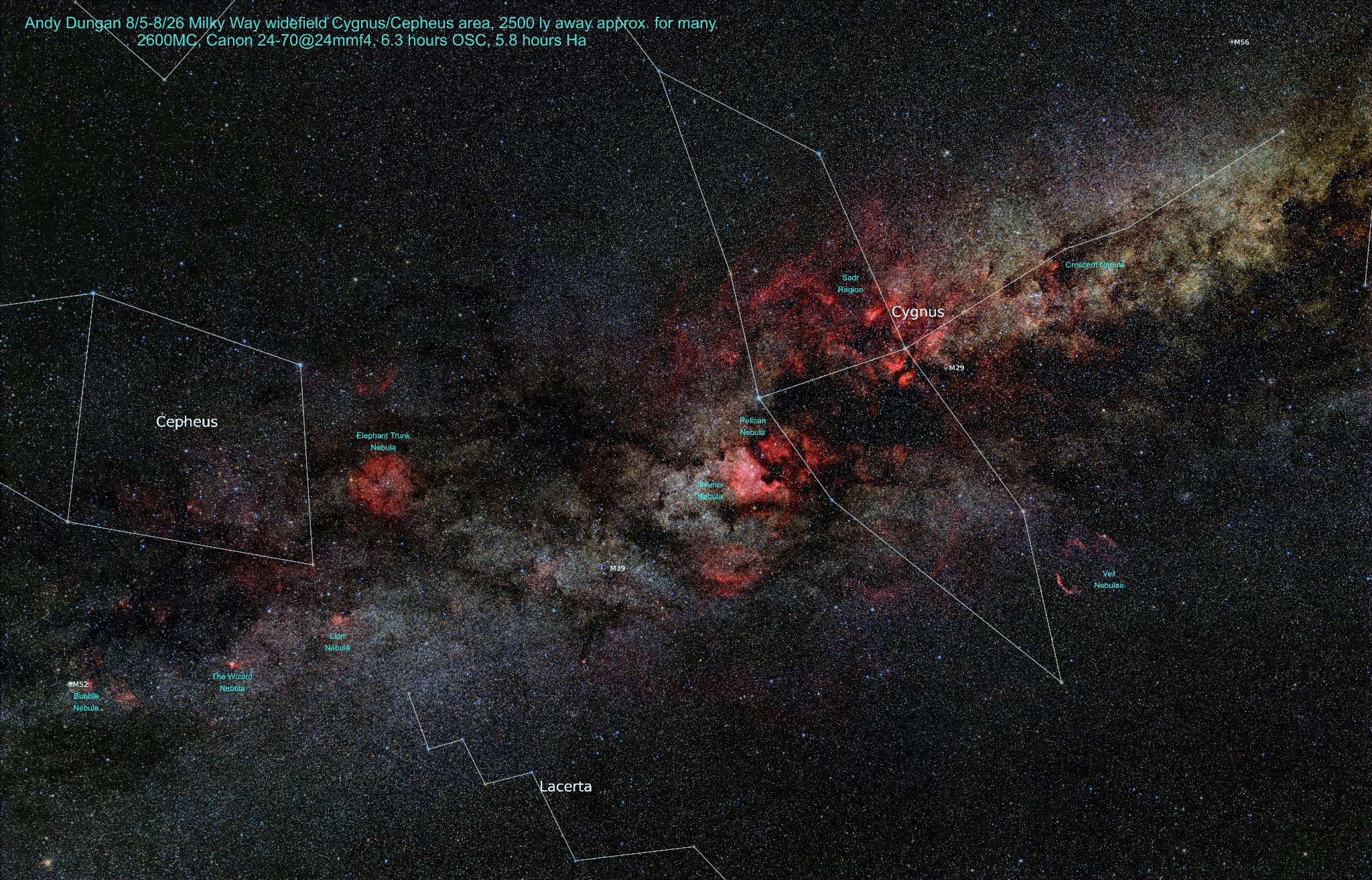
Milky Way Big View of Cygnus/Cepheus area
On 08/08/2026 01:00 am by Andy Dungan | Website | Near Cotopaxi, Colorado USA
I really do enjoy widefield images as much as deep sky photos. They give you the big perspective on what is out there in the night sky. And, you see what other objects are in the immediate area. It’s like a much prettier version of Stellarium.
Many of the objects in the photo are in the 2500 ly away range. Crescent Nebula is around 5000 ly away. Bottom line all of these nebulae lie within the Milky Way.
ASI2600MC Pro g100, Canon24-70@24f4, 38 10min pics (6.3 hours) exposure +darks/biases/flats,
Ha 35 10min pics (5.8 hours) exposure, taken over multiple nights
AM5/ASIair+, Askar 32mm guidescope with ASI120mini for guiding
PixInsight 100%.
This is a challenging picture to compose and photograph. My skill set for widefield photos is improving and this pic demonstrates some real improvements. I used the AM5/ASIair+ with a Canon 24-70 set at 24mm. I have a rather unique rig I designed and use for these kinds of photographs. The big advantage of using the AM5/ASIair+ is that I can take 600 sec exposures and take Ha images as well. It is the combining of the Ha image with the regular OSC image that gives the rich red color (Ha) to the photograph and allows you to easily see the many popular nebulae that can be photographed in this region. By using a 2600 with a 24mm lens you get a FOV of about 34°. With the ASIair+ the plate solve feature will not work on any view that has a FOV > 33°. This limitation of the ASIair+ makes taking ultra wide photographs quite challenging. You must either swap lenses, use a zoom lens or use your guiding camera to get the picture setup. Once setup you then switch to the lens focal length (with a FOV > 33°) and you can take long exposure pics that when combined with the capabilities of PI gives a brilliant and star corrected image.