By Nanci McCraine | 2026-07-16
Order by: Trending (past 30 days)Date
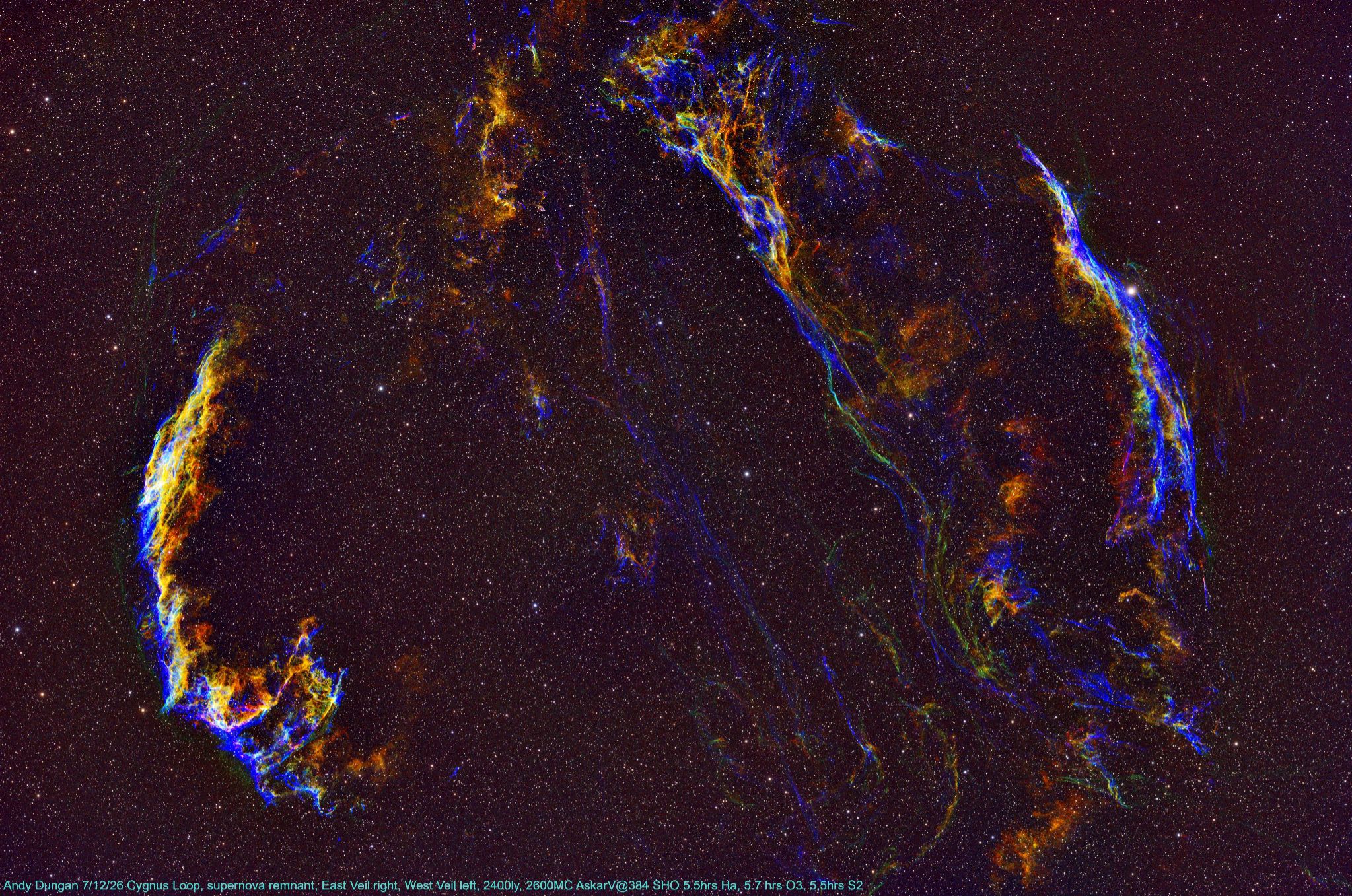
My first SHO image. Cygnus Loop, supernova remnant, East Veil right, West Veil left, 2400ly away
On 07/12/2026 01:00 am by Andy Dungan | Website | Near Cotopaxi, Colorado USA
The Veil Nebula is an exciting part of what is found in Cygnus. It is a supernova remnant (meaning a star that exploded). I took a wideview (384mm) so what is called the Cygnus loop could be seen. The right hand side is the East Veil Nebula and the left hand side is the West Veil Nebula. These are often photographed individually. Hubble Pallet modifies the colors so you can see the parts better. The Ha is represented by the gold/green. The O3 is presented by the blue. And, the S2 is represented by the red (not so much red, but you can see it which you can’t in an OSC pic).
ASI2600MC Pro g100, AskarV@384f4.8 +darks/biases/flats, Ha 33 10min pics (5.5 hours exposure), O3 34 10min pics (5.8 hours exposure), S2 33 10min pics (5.5 hours exposure), +darks/biases/flats taken over multiple nights
AM5/ASIair+, EAF, Askar OAG with ASI174mini for guiding
PixInsight 100%.
Well this was an adventure. I bought some inexpensive SHO filters from Svbony (only $279). I live in Bortle 1/2 so they seemed to work just great. After completing photography I took the RBG images and converted them to grayscale (luminance) images. Then I could process them the same way you process data from a mono camera, meaning I can do all the Hubble Pallet things. I created an SHO image by putting the S2 data in the red channel, the Ha data in the green channel and the O3 data in the blue channel. After some revising using NarrowbandNormailization you see the result. Once the SHO image was created much of the processing is the same as an image in PI.
This adventure will continue in the next week I will finish processing exactly the same view using my 2600MM (Mono) camera and then will be able to compare the results to the above.