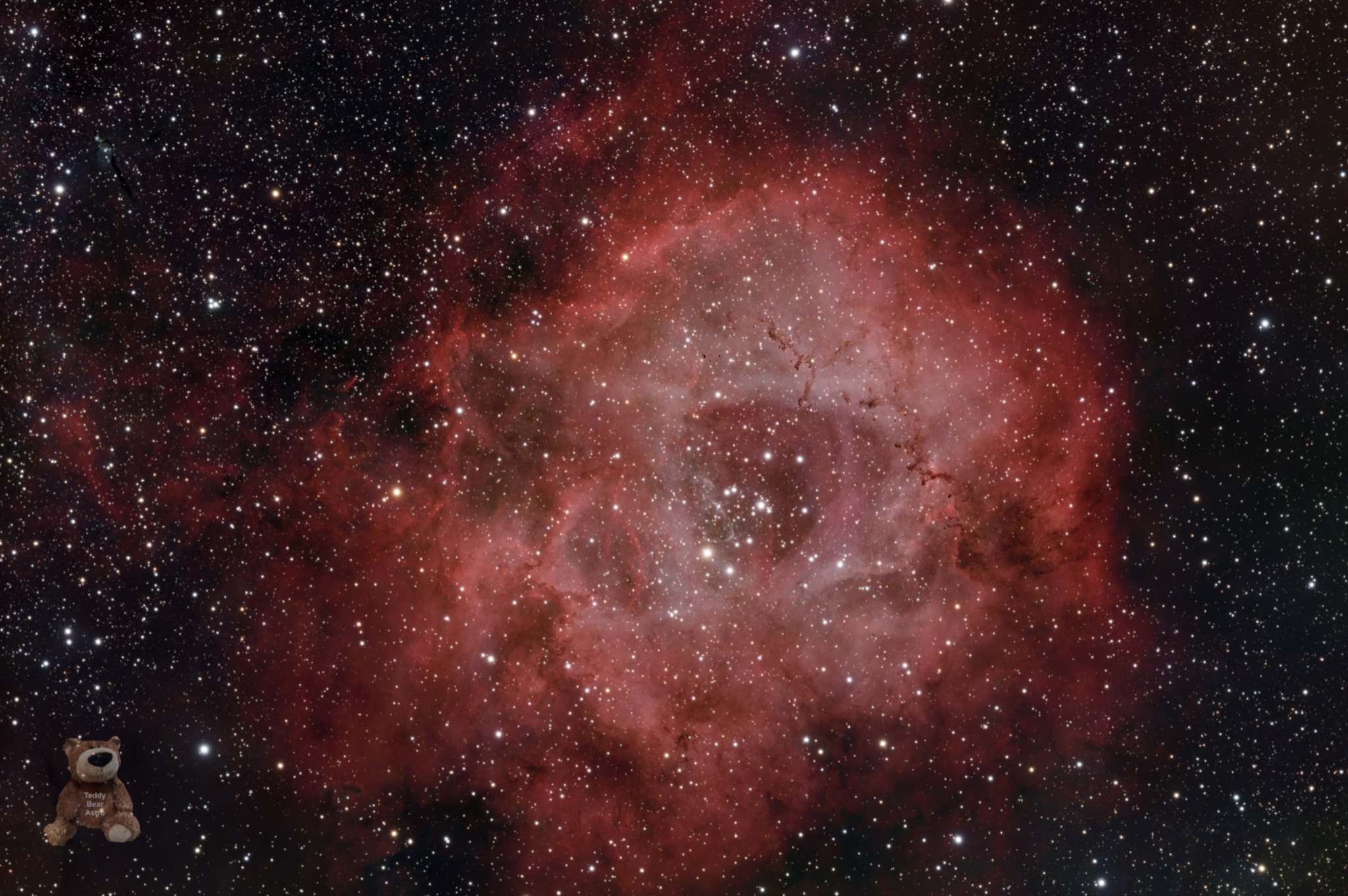
By Vaun Fiedler | 2026-01-21
Order by: Trending (past 30 days)Date
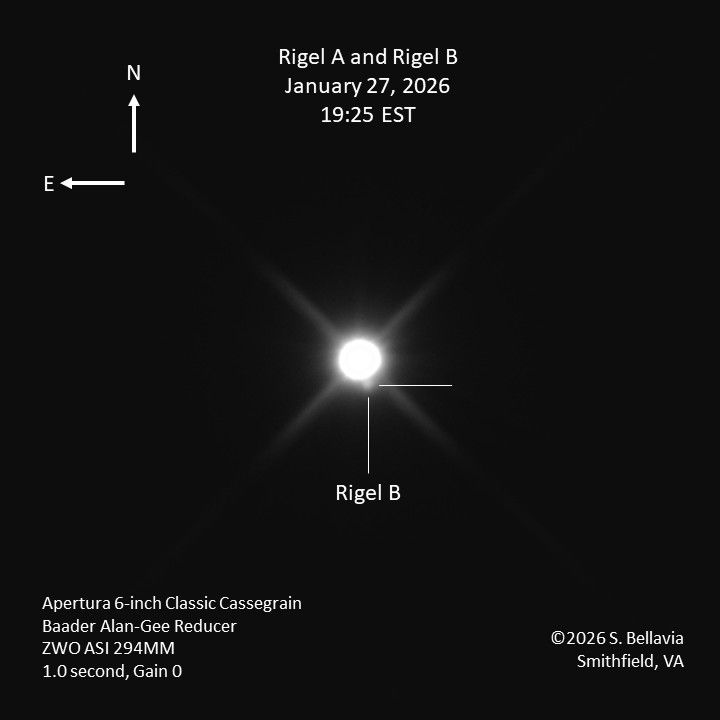
Rigel A and Rigel B
On 01/27/2026 07:25 pm by Steven Bellavia | Website | Smithfield, VA
I was trying to get Sirius B, which I have never achieved.
While I was waiting for Sirius to clear the trees, I started on Rigel, which is also a multi-star system, and a difficult to see or image Rigel B, which is itself is a multiple star system.
I did not get Sirius B but I did get Rigel B
The bright Star Rigel, Beta Orionis, Orion's left Knee (our right) is 860 light-years away. This massive star is about 70–80 times the Sun's diameter and roughly 90,000 times more luminous. It has a companion, Rigel B.
Rigel B is composed of at least two, and often considered three, smaller blue-white main-sequence stars (designated Ba, Bb, and sometimes C).
The main companion, Rigel B, is itself a spectroscopic binary with components that orbit each other in just 10 days.
A third star (often labeled C) has been identified within the system, orbiting the other two with an estimated period of 63 days.
All three stars of B (Ba, Bb, C) orbit the primary supergiant, Rigel A, in a system spanning over 2,500 AU
The position angle (P.A.) of Rigel B (the companion to the primary star Rigel A) is approximately 201° to 204°. This indicates that the secondary star lies south-southwest of the main blue-white star. The separation between Rigel A and B has been measured around 9.4" to 11.2" in recent decades.
Telescope: Apertura 6-inch Classic Cassegrain with Baader Alan-Gee reducer, which brings it to f/7.1, 1085mm focal length
Camera: ZWO ASI 294MM Pro Camera, cooled to -10 Celsius
SkyWatcher EQ6R-Pro equatorial mount
Mele mini computer running APT software
single 1-second image, Gain 0
processed in PixInsight