
By Armando Caussade | 2025-10-10
Order by: Trending (past 30 days)Date
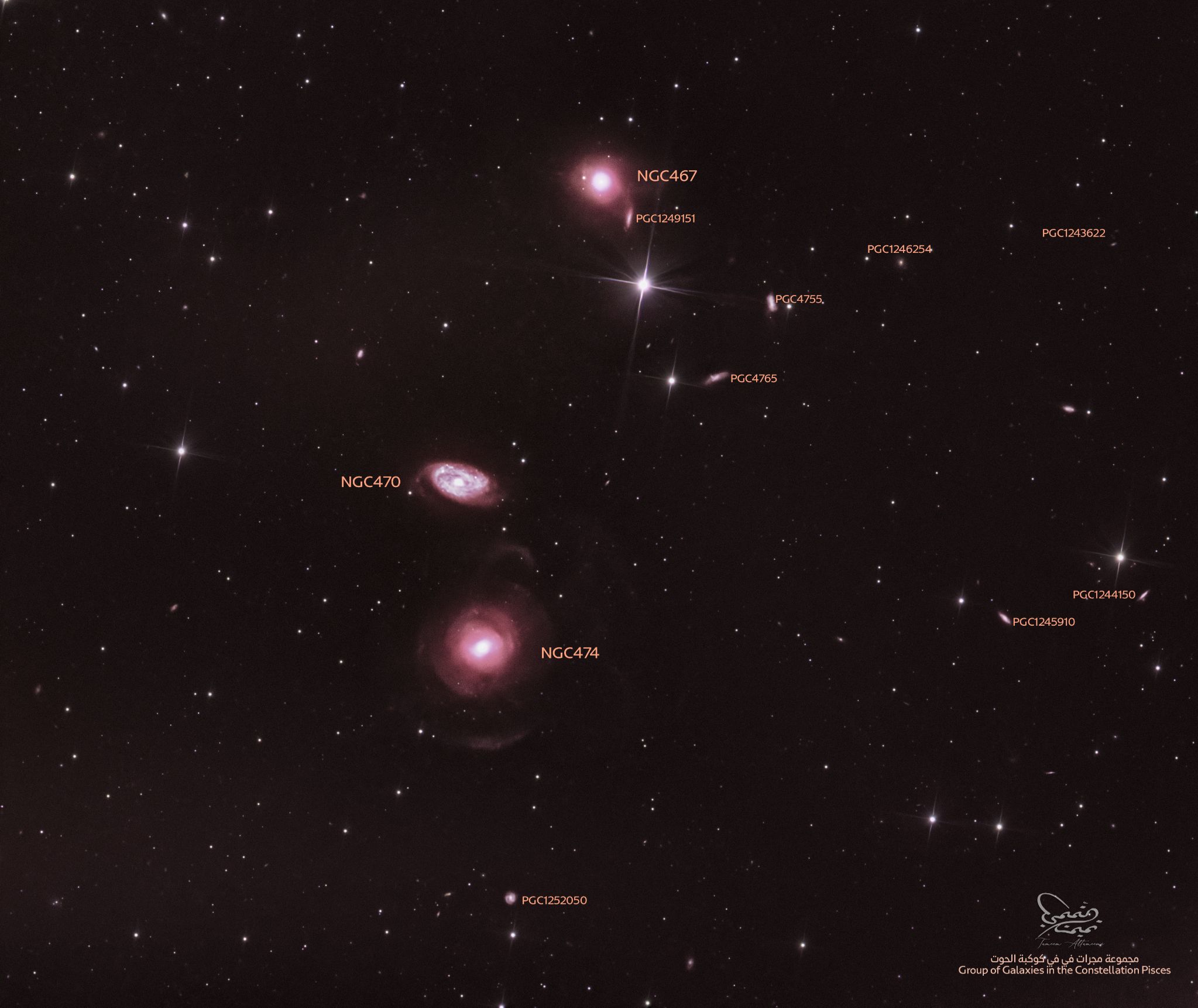
Interacting Galaxies NGC 474 and NGC 470 in Pisces
On 10/25/2025 12:00 am by Tameem Altameemi | Website | United Arab Emirates
In the constellation Pisces, two fascinating galaxies: NGC 474 and NGC 470, are locked in a slow gravitational interaction that reveals the dynamic nature of galaxy evolution. This deep-sky image, captured from the clear desert skies of the United Arab Emirates, highlights the extraordinary contrast between these two systems: one an ancient elliptical galaxy enveloped in faint shells, and the other an active spiral galaxy undergoing star formation.
NGC 474, located approximately 91 million light-years from Earth, is classified as an elliptical galaxy (E4) and is renowned for its spectacular system of tidal shells. These faint, concentric layers resemble ripples in water and are believed to be remnants of past mergers with smaller companion galaxies. These shells provide compelling evidence of galactic cannibalism, an essential process through which large galaxies grow over cosmic time.
Just to the side lies NGC 470, a spiral galaxy situated about 113 million light-years away. Unlike the smooth and diffuse structure of NGC 474, NGC 470 features well-defined spiral arms and an active galactic disk. Astronomers believe that the gravitational interaction between NGC 470 and NGC 474 is responsible for the distortions observed in both galaxies. The encounter has likely triggered bursts of star formation in NGC 470, while the tidal forces have sculpted the dramatic shells around NGC 474.
The field of view also contains several distant background galaxies extending hundreds of millions of light-years farther into space. These fainter members: including NGC 467, PGC 4755, and PGC 1246254, reveal the remarkable depth of the image and illustrate how a single frame can capture structures spanning nearly a billion light-years across the universe.
This astrophotograph not only documents a cosmic interaction in progress but also provides insight into how galaxies grow, merge, and transform over time, reminding us that the night sky is not static, but alive with motion on a grand scale.
Telescope: Sky-Watcher Quattro 200P (200mm f/4 Newtonian reflector)
Mount: iOptron HAE43 harmonic mount
Camera: ZWO ASI183MM Pro (cooled monochrome)
Filter Wheel: ZWO 36mm Electronic Filter Wheel
Filters: ZWO LRGB 36mm filters
Guiding: Svbony 30mm guide scope + ZWO ASI120MM
Acquisition: ASIAir Plus
Total Integration Time: 9 hours 30 minutes
Processing: PixInsight & Photoshop
