By Kevan Hubbard | 2025-10-20
Order by: Trending (past 30 days)Date
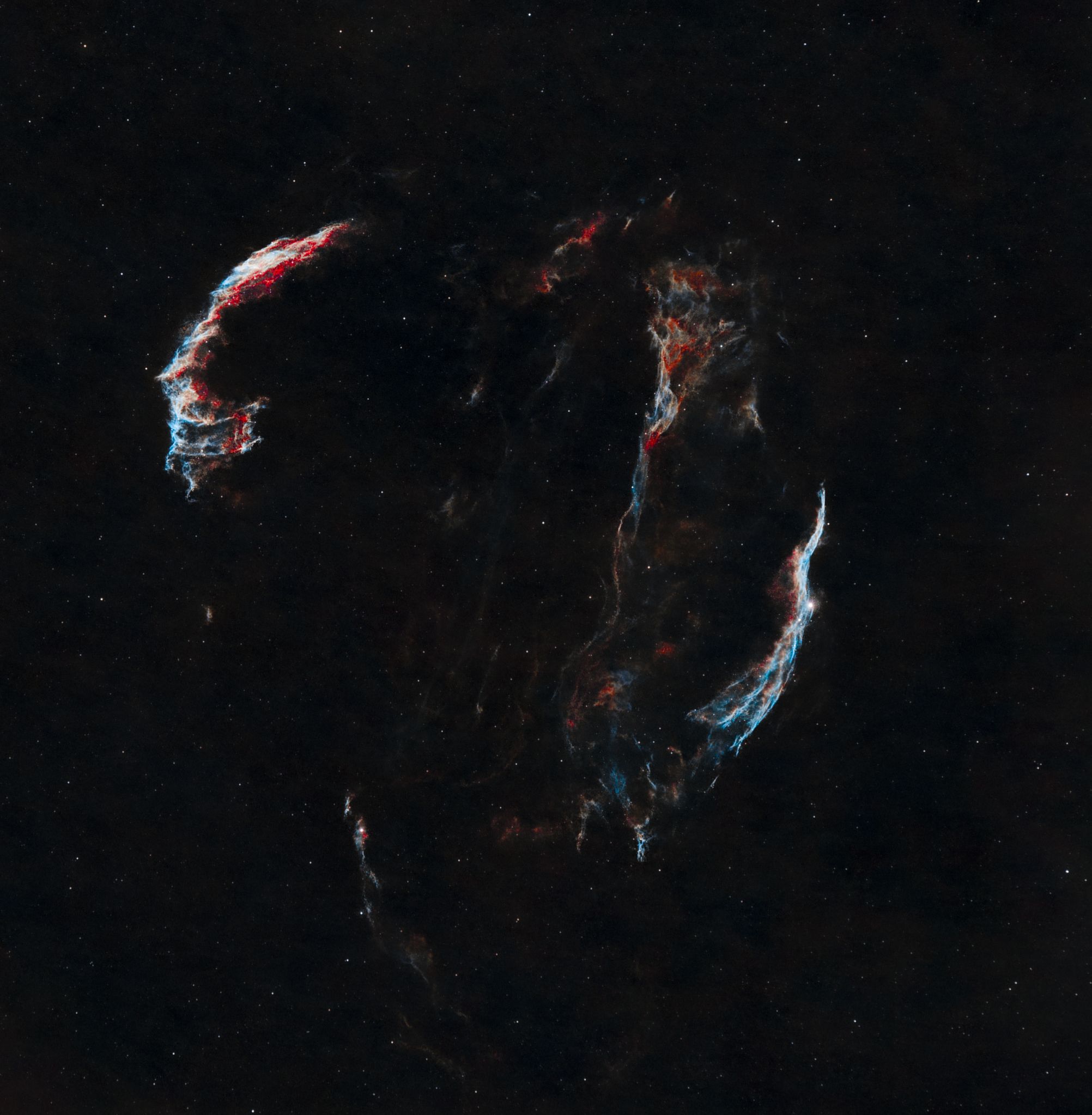
The Veil of Cygnus — Supernova Remnant (NGC 6960, NGC 6992, IC 1340)
On 10/18/2025 12:30 am by Aquib Ali Ansari | Website | Jaipur, Rajasthan, India
This image captures the Veil Nebula, part of the Cygnus Loop Supernova Remnant, located about 2,400 light-years away in the constellation Cygnus. What we see here are the delicate remnants of a massive star — around 13 times the mass of our Sun — that exploded roughly 5,000 years ago.
The intricate red and blue filaments trace emission from ionized Hydrogen (Hα) and Oxygen (OIII), glowing as the expanding shockwave interacts with interstellar gas. Despite being one of the faintest nebulae in the northern sky, the structure spans an area six times larger than the full Moon.
This image was captured from Jaipur, India (Bortle 8 urban skies) using a ZWO ASI533MC Pro camera, Samyang 135mm f/2 lens, and Optolong L-Ultimate dual narrowband filter. With 6.5 hours of integration over two nights, it reveals the ghostly beauty of this ancient stellar explosion — a delicate balance of chaos and art in our cosmos.
🔭 Equipment & Capture Details:
• Mount: Sky-Watcher Star Adventurer GTi
• Lens: Samyang 135mm f/2
• Camera: ZWO ASI533MC Pro (OSC)
• Guide Camera: ZWO ASI120MM Mini
• Guide Scope: SV167 30mm
• Controller: ZWO ASIAIR Plus
• Filter: Optolong L-Ultimate 2"
• Exposure: 78 × 300s (Lights), 35 Darks, 80 Flats, 80 Bias
• Integration Time: ~6.5 hours over two clear nights
• Location: Jaipur, India — Bortle 8
Stacked and processed in Siril and Photoshop, focusing on enhancing faint oxygen (OIII) and hydrogen (Hα) structures while maintaining a natural color balance and detail-rich presentation.