By Christoph Stopka | 2025-03-17
Order by: Trending (past 30 days)Date
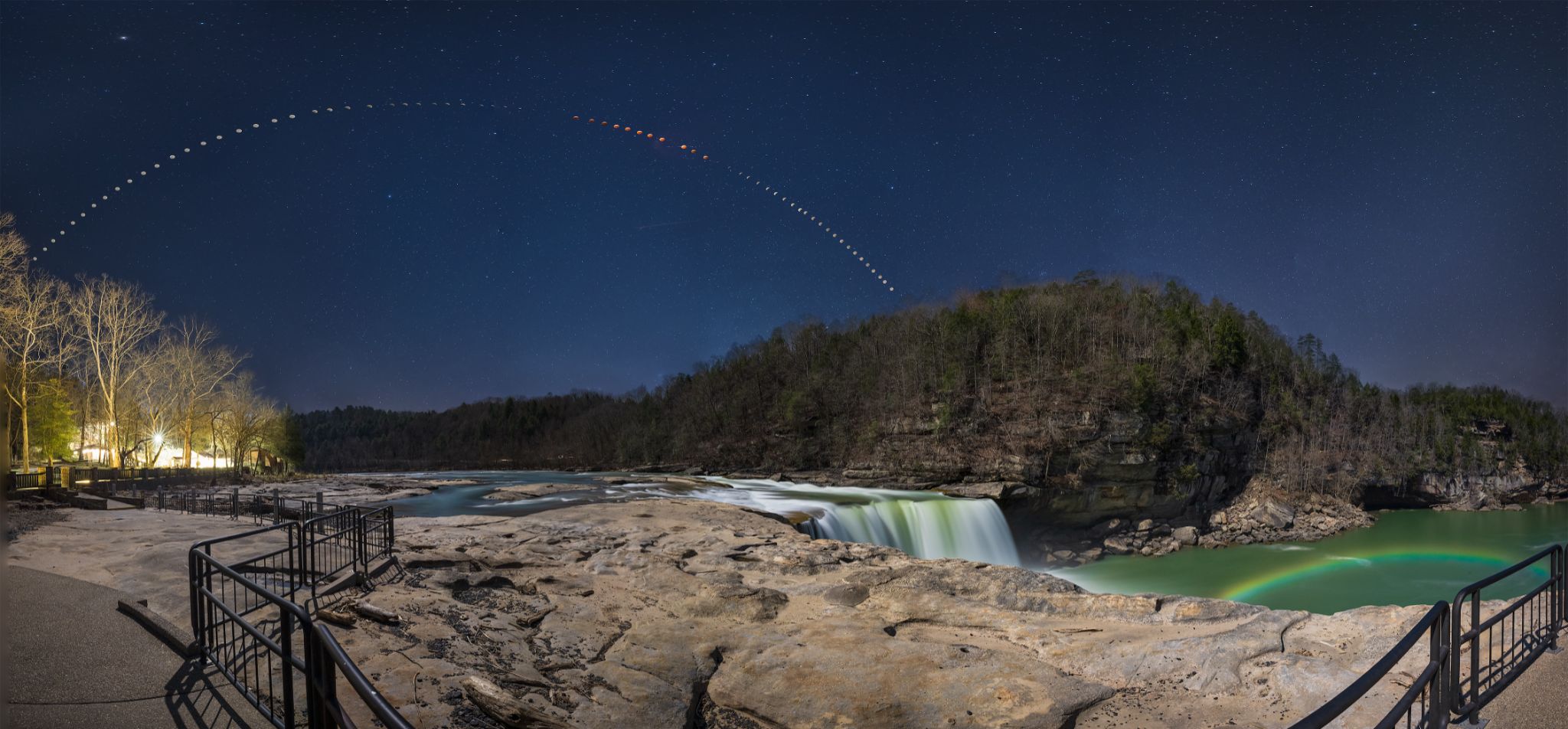
Cosmic Two for One
On 03/14/2025 by Billy Buchanan | Website | Corbin, KY, USA
The fencing at the park provides dual leading lines to the arc of the moons and the arc of the moonbow. The two arcs provide a useful commentary about the nature of the cosmos in terms of their relative scale (e.g., the moonbow is fairly small and is dwarfed by the size of the celestial formed arc). It also shows two relatively rare phenomena simultaneously in the same composite image. The full-sized image can be found here: https://live.staticflickr.com/65535/54394612466_f429b3dcc3_k.jpg, since the attached image is scaled down to 30% of the size. Also, if used please credit the photo to my company Narcoleptic Nightscapes.
Nikon Z9 (unmodified), Nikkor 20mm f/1.8S lens, Nodal Ninja M2 Giga panoramic head, Photix intervallometer.
This is a 7 x 2 panorama of the recent total lunar eclipse. Everything was shot with a Nikon Z9 body (unmodified) and Nikkor 20mm f/1.8S lens. To capture the sky I shifted the aperature on the lens to f/2.2 ramped up the ISO to 3200 and took a single shorter exposure (10 seconds) at each of the 7 camera positions with the camera tilted up 40°. The foreground images were captured with much longer exposures ranging from 1 minute (for the left most panel) to 2 minutes (for the three right most panels) with an aperture of f/11 and ISO 1600. The images of the moon were all captured at f/11. For the phases prior to totality an ISO of 200 was used and during totality an ISO of 800 and 10 second exposures.
Due to a combination of a large crowd and some technical difficulties with my equatorial mount I did miss a few shots of the moon through out the evening. Many of the moons that form the upward rising arch are cloned from the shot of the moon I took at the start of the penumbral phase and dodged a bit to give the appearance of the fuller moon, the moon immediately following that first shot was also a clone. I'm more than happy to submit a photo that only includes the actual photos taken as is.
Regarding processing, I used the same technique typically used for wide angle total solar eclipse composites, but applied it to the individual panels of the sky. I did have to use some burning to ensure the moons would be lighter enough by comparison for the lighten blending mode to work properly, but did not do much beyond that. I then exported a TIFF with the moons composited into the panel for the corresponding sky panel; I took overlapping photos of the moon through out the evening so I could mitigate lens distortion as the moon made its way towards the edge of the lens. There are four sky panels that include the moon. Then I loaded all of the composited sky images, the three remaining sky images, and all seven foreground exposures into PTGui to perform the panorama stitching process; I manually masked some of the panels to mitigate issues with color matching of the sky at the horizon line due to the trees. I exported the stitched panorama as a DNG and did some minor editing in adobe camera raw to fix/correct stitching artifacts and get more consistency in the sky. Lastly, I used Photoshop to provide some minor noise reduction to the entire image (I used noise reduction on the sky images earlier during processing) and then to sharpen the image some.

