By Mohamed Mohamed | 2026-11-12
Order by: Trending (past 30 days)Date
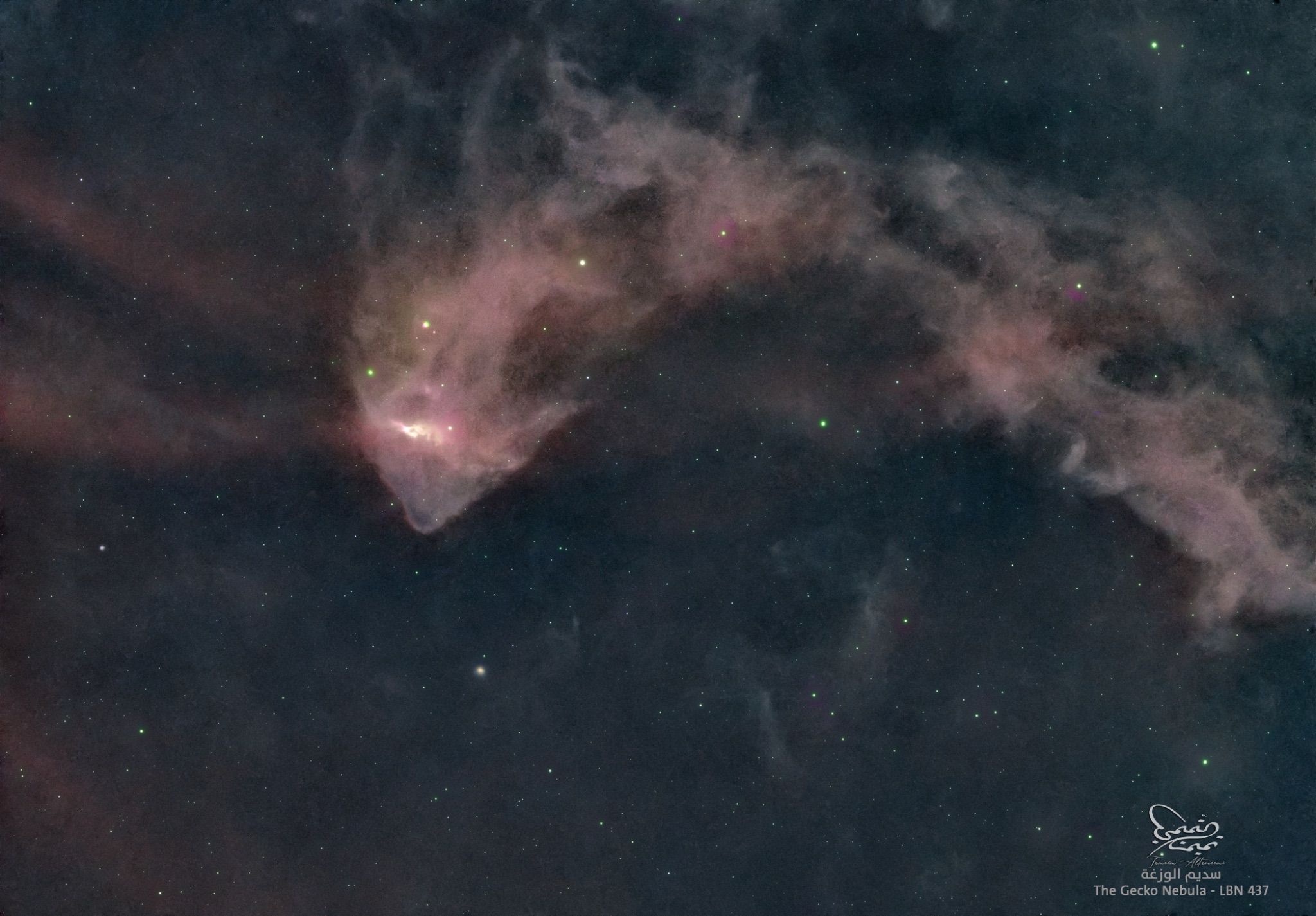
The Gecko Nebula (LBN 437) in Lacerta
On 11/07/2026 01:00 am by Tameem Altameemi | Website | Al Qou, United Arab Emirates
The Gecko Nebula, also catalogued as LBN 437, is a faint interstellar cloud of gas and dust located in the constellation Lacerta.
Its distinctive curved structure resembles a gecko, giving the nebula its popular nickname. This region contains a mixture of reflection nebulosity, emission from ionised hydrogen, and dark dust clouds that obscure the light of background stars.
The image reveals the delicate structure of the surrounding interstellar material, including the brighter region near the nebula’s head and the faint clouds of gas and dust extending across the field.
I captured this image from the United Arab Emirates over six observing nights between 9 October and 7 November 2026. I mainly used weekends, carefully selecting nights with clear skies and minimal moonlight to capture the faint details of this challenging target.
A total of 281 exposures, each lasting 180 seconds, were combined using H-alpha and LRGB data, resulting in 14 hours and 3 minutes of total integration time.
* Telescope: Sky-Watcher Evostar 72ED
* Mount: ZWO AM3N
* Filters: H-alpha (50 exposures), Luminance (130), Red (37), Green (32), and Blue (32)
* Exposure time: 180 seconds per frame
* Total integration: 14 hours and 3 minutes
Image Processing:
The image was processed using a combination of H-alpha and LRGB data. The luminance frames were used to reveal the fine structures and faint dust clouds, while the RGB exposures provided the natural colours of the stars and surrounding nebulosity. H-alpha data were incorporated to enhance the visibility of ionised hydrogen emission within the nebula.
The individual exposures were calibrated, aligned, and stacked, followed by noise reduction, colour adjustments, and careful contrast enhancement to bring out the faint interstellar structures.