By Mandy Daniels | 2026-10-16
Order by: Trending (past 30 days)Date
Chasing Darkness, Capturing Eternity: When Earth’s Lights Meet the Milky Way
On 10/14/2026 08:27 pm by Jelieta Walinski Ph.D | Desert bloom Observatory, AZ, USA
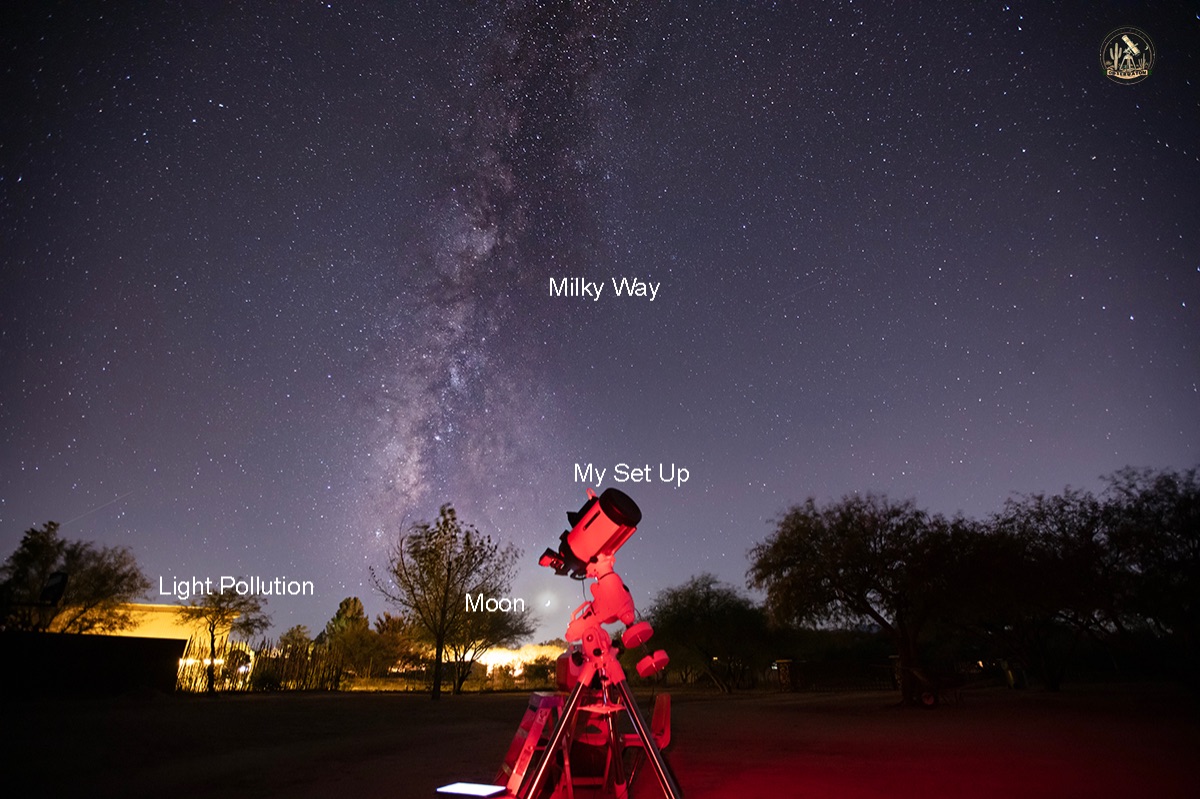
Beneath a sky scattered with countless stars, my telescope stands ready to explore the wonders of the cosmos. Above it, the magnificent Milky Way stretches across the heavens—a luminous river of ancient starlight carrying the story of our galaxy. Yet even in this beautiful moment, two sources of unwanted brightness remind me that capturing the darkness of the universe requires more than a telescope and a camera. It requires darkness itself.
“The first challenge is artificial light pollution.” The golden glow rising from the horizon comes from human-made lights—streetlights, buildings, and other sources of outdoor illumination. This scattered light brightens the night sky, reducing contrast between the stars and the background. Faint stars, delicate dust lanes, and subtle structures within the Milky Way can disappear into the glow. Even under a naturally dark sky, a nearby source of artificial light can diminish the details that an astrophotographer hopes to preserve.
“The second challenge is our natural celestial neighbor: the Moon.” Unlike artificial light pollution, moonlight is a natural part of our universe, reflecting sunlight toward Earth. Nevertheless, a bright Moon can illuminate the atmosphere and create a luminous background that washes out faint celestial objects. Its effect depends on its phase, altitude, position relative to the target, and the transparency of the atmosphere. A full Moon generally presents a greater challenge than a thin crescent, especially when photographing the faint structures of the Milky Way.
Scientifically, both sources of illumination reduce the contrast needed to reveal faint astronomical details. Longer exposures and image stacking can help collect more signal, but they cannot completely restore details overwhelmed by a bright sky. This is why astrophotographers often seek moonless nights, observe around the New Moon, choose locations far from artificial lighting, and carefully plan their imaging sessions.
And so, beneath this vast celestial ocean, I am reminded that darkness is not emptiness. It is the precious canvas upon which the universe reveals its wonders.
My telescope gathers the ancient light of distant stars, while the surrounding glow teaches me patience, preparation, and respect for the delicate balance between humanity and the night sky.
We do not need to extinguish every light to appreciate the stars. We need to use light wisely, direct it where it belongs, and preserve the darkness that allows the universe to speak to us.
“Protect the beauty you see today, so it may live tomorrow!”
*Capturing Light Across Time!*
— Desert Bloom Observatory
EF16-35mm f/2.8L II USM, Canon EOS 5DS, Manfrotto Tripod, Canon Trigger release
In photoshop just to increase little sharpness