By Peter Roof | 2026-10-13
Order by: Trending (past 30 days)Date
Saturn Unveiled: A World of Rings, Gaps, and Golden Belts
On 10/09/2026 01:19 am by Jelieta Walinski Ph.D | Website | Desert bloom Observatory, AZ, USA
*Where celestial beauty meets the wonders of planetary science.*
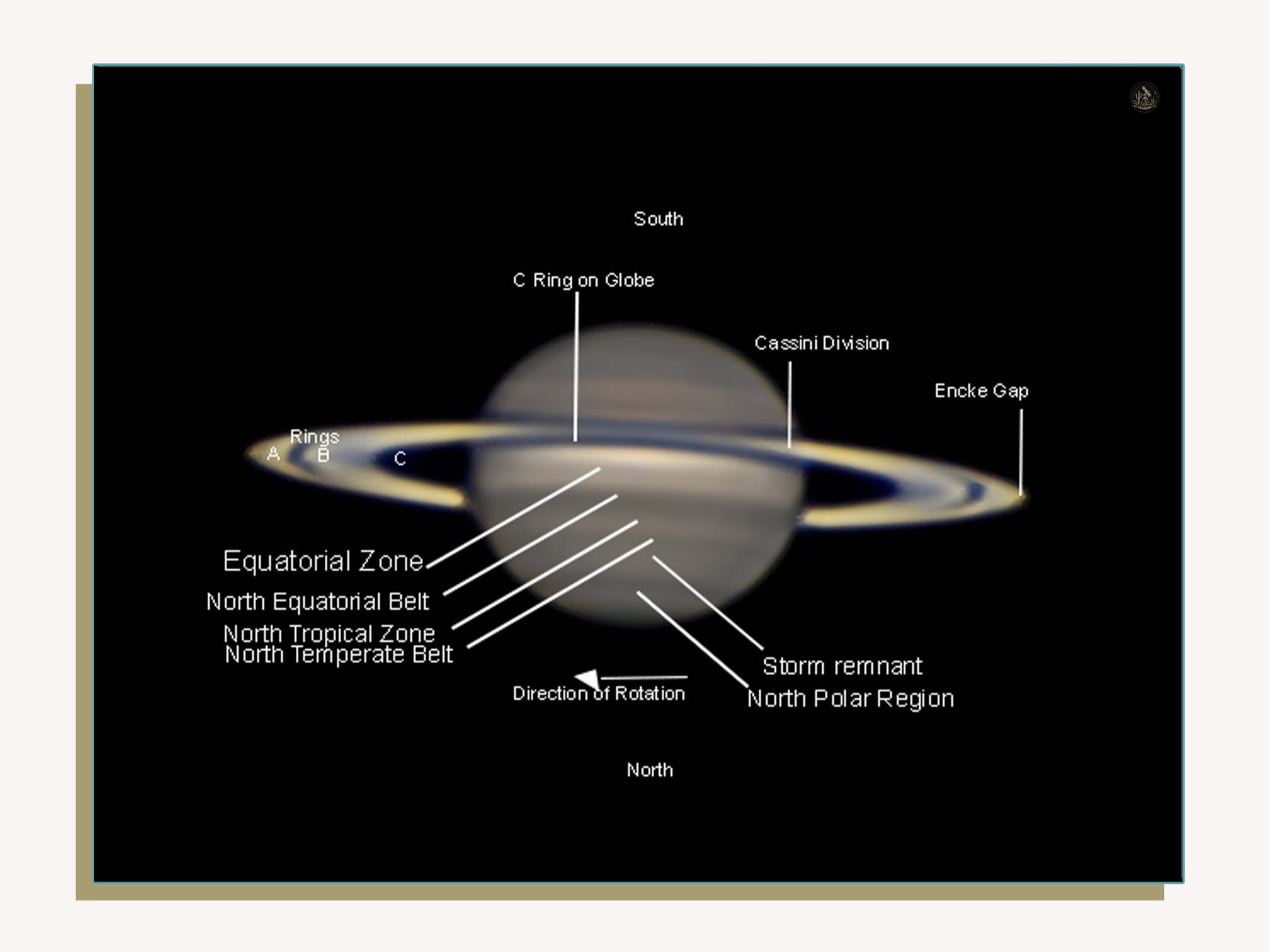
Beyond its magnificent silhouette, Saturn reveals a remarkable world of intricate rings and delicate atmospheric bands. Each labeled feature in my planetary capture tells a small part of the story of this distant gas giant—a world shaped by gravity, motion, atmospheric circulation, and the interplay of light.
**Exploring the Features of Saturn**
**1. C Ring on the Globe**
The C Ring is the innermost of Saturn's three main visible rings. It is relatively faint and translucent, allowing some light from Saturn's atmosphere to pass through when the ring crosses in front of the planet's disk. This overlapping view reveals the delicate relationship between the rings and the globe beneath them.
**2. The Cassini Division**
One of Saturn's most recognizable features, the Cassini Division is a broad gap between the outer A Ring and the brighter B Ring. It is largely depleted of ring particles because of gravitational resonances with Saturn's moon Mimas, which influence the orbits of particles in this region.
**3. The A Ring**
The A Ring is the outermost of Saturn's three main bright rings. It contains countless icy particles orbiting the planet, along with narrow gaps and waves shaped by gravitational interactions with Saturn's moons. The Encke Gap lies within this ring.
**4. The B Ring**
The B Ring is the middle and generally brightest of the three main rings. Its dense concentration of particles gives it a brilliant appearance, although its structure varies considerably from one region to another.
**5. The C Ring**
Located inside the B Ring, the C Ring is darker and more transparent. Its delicate appearance allows astronomers to study how ring material can differ in density and brightness. When projected against Saturn's globe, it may appear as a subtle, shadowy band.
**6. The Encke Gap**
The Encke Gap is a narrow gap within the A Ring, maintained largely by the gravitational influence of Saturn's small moon Pan, which orbits within it. This feature demonstrates how even small moons can sculpt the enormous ring system.
**Exploring Saturn's Atmospheric Bands**
Saturn's atmosphere is divided into alternating zones and belts. These broad bands are associated with different wind patterns, cloud structures, and atmospheric circulation.
**7. Equatorial Zone**
The Equatorial Zone is a relatively bright region near Saturn's equator. Its appearance reflects the distribution of clouds and atmospheric hazes in this part of the planet, which can change with time and viewing conditions.
**8. North Equatorial Belt**
The North Equatorial Belt is a darker atmospheric band north of the equator. It contrasts with the brighter zones around it and is associated with strong winds and complex cloud activity.
**9. North Tropical Zone**
The North Tropical Zone is a lighter atmospheric region farther north, separating neighboring darker belts. Its subtle color and brightness depend on atmospheric conditions, cloud altitude, and haze.
**10. North Temperate Belt**
The North Temperate Belt is a darker band at higher northern latitudes. Like Saturn's other belts, it reflects the planet's dynamic atmosphere, where powerful winds organize clouds into broad, alternating patterns.
**A Portrait of Motion and Mystery**
Saturn's rings are not solid sheets but immense collections of icy and rocky particles, each following its own orbit. Its atmospheric bands, meanwhile, reveal a constantly moving world of winds, clouds, and changing weather.
Together, these features transform Saturn from a distant point of light into a complex planetary system waiting to be explored.
Every detail I label in my image deepens my appreciation for the science behind the beauty. Every processing session teaches me something new, and every attempt brings me closer to revealing the wonders hidden in the light captured by my telescope.
My Saturn journey continues—with patience, practice, and an enduring curiosity about the universe.
**Capturing Light Across Time!**
— Desert Bloom Observatory, Arizona, USA
Telescope: Celestron EdgeHD CGE 8” f/10 Aplanatic Schmidt Cassegrain Telescope
ZWO ASIAir Pro Wifi Camera Controller
Camera: ZWO ASI676MC high Speed/High Sensitivity Low Noise Planetary Camera
Mount: Sky-Watcher EQ-6R Pro Computerized Equatorial Mount S303000
Asi462MC
Autostakkert, Registax, PS