By Alexander Krivenyshev | 2026-08-25
Order by: Trending (past 30 days)Date
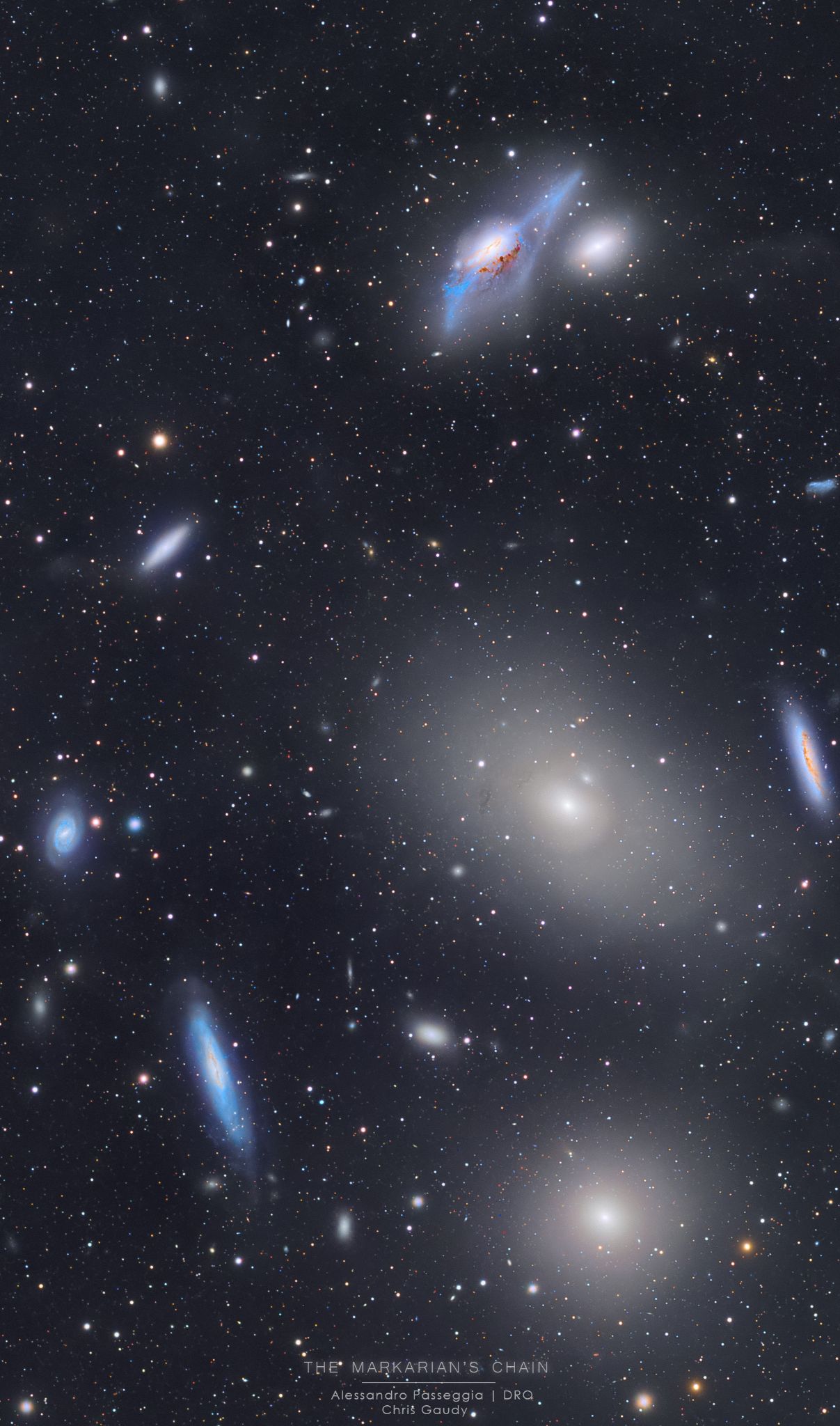
The Markarian's Chain
On 04/09/2026 12:00 am by Alessandro Passeggia | Website | Astrocamp, Neprio, Spagna
Good morning, cosmologists!
Today, I'm giving you a sneak peek at something truly special: a deep-field image of the Markarian Chain with incredible quality, preserving the detail in the original images, allowing us to analyze the structure of individual galaxies.
》Objective 🚀: The main goal was not only to obtain as many details as possible from the galaxy chain but also to understand the structures of individual galaxies. Pushed in this way, the image can be used for some scientific study with a broad focus on HOW these galaxies are evolving.
The sessions were held over several nights with the same instrument listed in the data, since in the remote areas of Spain, the times when the skies were particularly clear were chosen, integrating the different "RGB" channels with the monochrome camera and the Luminance camera over the different evenings to obtain the IFN present in the photograph (although very small).
Comment 💭: When we talk about astrophotography, we're not just talking about a simple photograph, but about knowing, exploring, hypothesizing things that our brain cannot quantify, seeing things that no human being in history has managed to achieve, or perhaps even touch with our hands.
Astrophotography isn't just about seeing something new, it's about UNDERSTANDING how small we are compared to everything around us, seeing the reality of things clearly, extrapolating the fine details of these distant cosmic objects, understanding what they're made of and what's happening at that specific point, revealing new knowledge to humanity.
There's a phrase that hasn't left my head since I began my passion for astronomy, and it's something I constantly think about when I take and process images of the cosmos:
"Now I have become the Pioneer, the explorer of worlds."
------
| This astrophotography was born in collaboration with Chris Gaudy (a dear friend of mine abroad), director of a small observatory for Astrophotomarket.com in the clear skies of Spain, who was amazed by what we were able to extract from this image. :)
Clear Skies! 💫
☆ D A T A ☆
Telescope 🔭: SkyWatcher Esprit 120mm;
Astronomical Camera 📸: ZWO ASI 2600MM PRO;
Mount 🚀: AM5;
Accessories 🟡: EAF, APM Riccardi APO-Reducer 0.75× M63;
Software 🖥: PixInsight, Adobe PhotoShop & LightRoom.
Astrofield, Neprio (Spain 🇪🇸) - Bortle 1 | 21.83 MQ;
Integration ⏳️: 41.08 Hrs | 2026/04/09 - 2026/06/06.
¤ SET ¤
》⚪️ Antlia Luminance 2.00" - 600s / Frame: 106 | 17:40h.
》🔴 Antlia Red 2.00" - 300s / Frame: 24 | 02:00h.
》🟢 Antlia Green 2.00" - 300s / Frame: 25 | 02:05h.
》🔵 Antlia Blue 2.00" - 300s / Frame: 24 | 02:00h.
☆¤☆
》 Instagram: dro0.x & astrophotomarket
○ Credit. Image: Alessandro Passeggia (DRO) | Chris Gaudy.
Telescope 🔭: SkyWatcher Esprit 120mm;
Astronomical Camera 📸: ZWO ASI 2600MM PRO;
Mount 🚀: AM5;
Accessories 🟡: EAF, APM Riccardi APO-Reducer 0.75× M63;
Software 🖥: PixInsight, Adobe PhotoShop & LightRoom.
Post-production was seriously complicated because the photo was presented in a monochrome sequence between Luminance and RGB channels. The first thing I did was remove the thermal noise and adjust the gradients in the photo, trying to obtain as much detail as possible in the relief as possible. I then applied the Blur plug-in. Subsequently, after PixInsight, I used various coloring techniques and masks to obtain the colors of the individual galaxies, creating a complete starless effect.