By Andy Dungan | 2026-06-29
Order by: Trending (past 30 days)Date
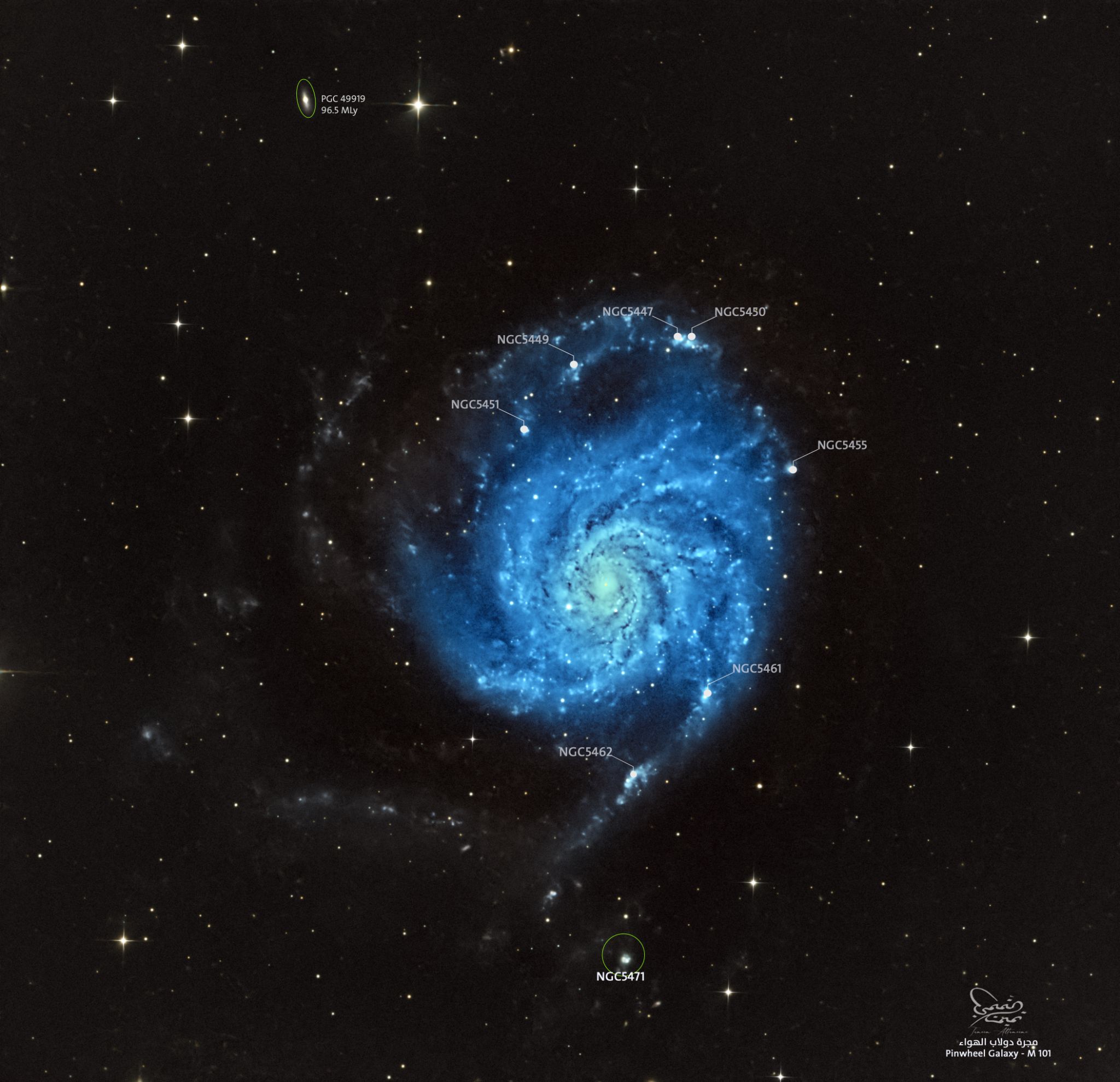
The Pinwheel Galaxy (M101): A Face-on Spiral Rich in Star Formation
On 06/20/2026 11:30 pm by Tameem Altameemi | Website | United Arab Emirates
The Pinwheel Galaxy (M101) is one of the finest examples of a face-on grand-design spiral galaxy visible from Earth. Located approximately 23 million light-years away in the constellation Ursa Major, it spans nearly 170,000 light-years across, making it significantly larger than our own Milky Way.
Discovered by Pierre Méchain in 1781 and later added to Charles Messier's catalog as M101, this magnificent galaxy is classified as a SAB(rs)cd spiral galaxy. Its loosely wound spiral arms are filled with enormous clouds of gas and dust where new generations of stars continue to form.
One of M101's most striking characteristics is the abundance of giant H II regions, vast clouds of ionized hydrogen illuminated by young, massive stars. Several of these stellar nurseries are visible in my image, including NGC 5461, NGC 5462, NGC 5455, NGC 5450, NGC 5449, and NGC 5471. Among them, NGC 5471 is particularly remarkable, as it is one of the brightest and most massive star-forming complexes known in any nearby spiral galaxy. These regions are responsible for much of the galaxy's blue appearance, which is dominated by hot, short-lived young stars.
Unlike many nearly symmetrical spiral galaxies, M101 exhibits an asymmetric structure. Astronomers believe this distortion is the result of past gravitational interactions with nearby companion galaxies. These encounters have likely compressed large clouds of gas within the spiral arms, triggering episodes of vigorous star formation that continue today.
My image also reveals one of M101's satellite galaxies, PGC 49919, located about 96.5 million light-years from Earth. Although it appears close to M101 in the sky, it lies much farther away along our line of sight, illustrating the remarkable depth contained within a single telescopic field.
This image was captured beneath the dark mountain skies of Ras Al Khaimah, United Arab Emirates, far from the effects of urban light pollution. Under these conditions, the delicate spiral structure and faint outer arms of M101 become visible, along with numerous distant background galaxies scattered throughout the field.
For me, M101 is one of the most rewarding spiral galaxies to photograph. Every additional hour of exposure reveals finer dust lanes, more intricate spiral structure, and increasingly faint star-forming regions, offering a deeper look into a galaxy where stellar evolution is actively unfolding on a truly enormous scale.
Sky-Watcher Quattro 200P (f/4 Newtonian Reflector)
ZWO ASI533MC Pro (cooled color camera)
Baader UV/IR-Cut L Filter
iOptron HAE43
Svbony 30 mm Mini Guide Scope
ZWO ASI120MM Guide Camera
ASIAir Plus
ZWO EAF
Exposure Details
70 exposures × 300 seconds
Total integration time: 5 hours 50 minutes
PixInsight and Adobe Photoshop.