By Patricio Leon | 2026-03-08
Order by: Trending (past 30 days)Date
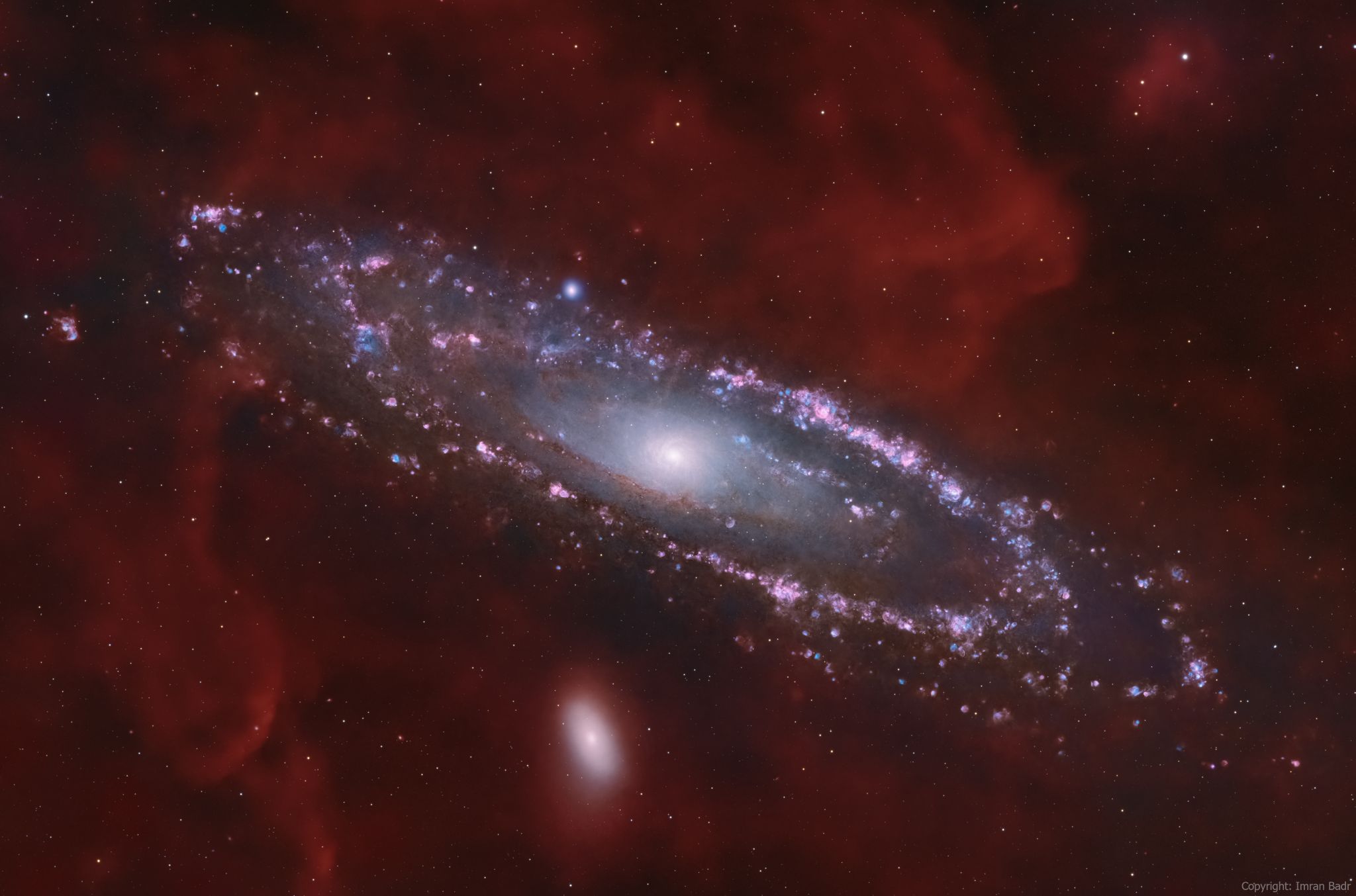
Andromeda galaxy, its Nebulae and the Foreground Hydrogen
On 11/30/2025 by Imran Badr | Website | San Jose, Bradley and Death Valley, CA
This deep view of the Andromeda Galaxy combines continuum-subtracted narrowband imaging with broadband color to isolate hydrogen emission while preserving the natural appearance of the galaxy’s stars and dust lanes. Across Andromeda’s spiral arms, hundreds of compact H II regions stand out as glowing knots of hydrogen gas, marking sites where massive young stars are actively forming. These star-forming complexes trace the structure of the galaxy’s spiral pattern in remarkable detail. Beyond the galaxy itself, faint arcs and diffuse clouds of hydrogen emission appear across the field. The result is a layered cosmic view: a distant spiral galaxy, 2.5 million light-years away, seen projected against faint foreground hydrogen drifting within our own Galaxy.
This image is best viewed in full resolution on a big monitor. Please see the full resolution image at: https://www.deepspacebackyard.com/m31-ionized-halo
Telescopes:
Askar FRA 300 pro
Sharpstar 13028 HNT
Mounts:
2xZWO AM3
Camera:
ZWO ASI2600MM Pro x2
ZWO ASI2600MC Pro
Filters:
Antlia 2.5nm S,H,O
Antlia 3nm Highspeed O3, and Ha
ZWO UVIR Cut
Exposures:
broadband: 4h52m
Ha: 215h35m (300s, 600s)
S2: 46h35m (300s, 600s)
O3: 132h50m (300s, 600s)
Total Integration: 400h
Software: PixInsight, Photoshop
Processing and Data Acquisition:
This was an extremely challenging project which tested my patience and skills to its limits. I captured first 30sec broadband frame in Aug 2024 to check framing and since then I spent more than two years to collect data in every clear night to accumulate 400 hours of data. Setting up scopes every clear night, doing polar alignment, focusing, guiding, planning...all of that doing that consistently for more than two years was tough to say the least. During this two year period, I travelled to darker skies of central California and Death Valley multiple times to collect the best frames. Packing everything, driving for 10 hours each time, setting up scopes there and then packing up in the morning to go back to the hotel for catching some sleep and then repeating the same process the bext night. I must say that it took a toll on my health and finances. What kept me going then...the desire to capture the best image of our galactic neighbor in unprecedented details. I cropped off the o3 arc because in my opinion that was a distraction. I have other images with that arc but the main idea of this image was to show the galaxy's nebulas in a way that has never been shown before. To achieve that goal, I started with continuum subtraction to remove broadband from narrowband data. Once I was satisfied with the amount of subtraction, I created an SHO image with continuum subtracted S, H and O. That gave me great details of the galaxy. The spiral in the core was looking great and extended all around the galaxy. The issue was the color. I then created a standard HORGB image and then used that as color for the SHO image. That was the key to get the colors I wanted. After that I enhanced the image with curves and histogram adjustments.