By Aayan Shaikh | 2026-02-28
Order by: Trending (past 30 days)Date
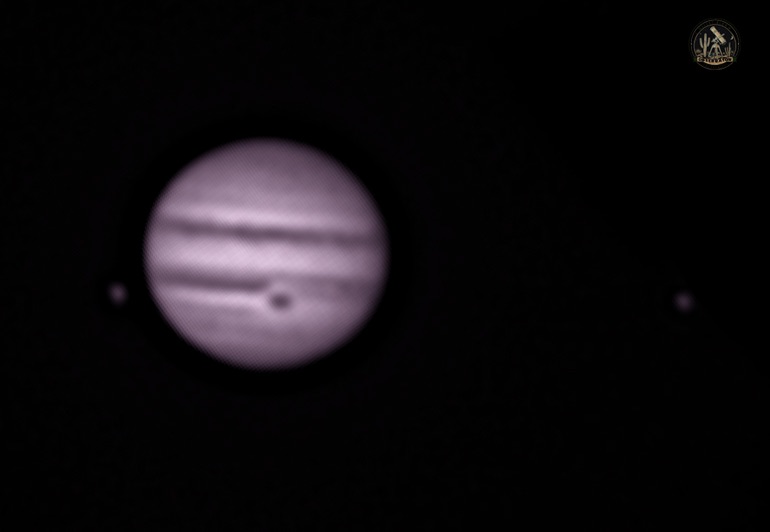
The Jovian Dance and the Crimson Eye
On 02/25/2026 12:16 am by Jelieta Walinski Ph.D | Website | Desert Bloom Observatory, AZ, USA
On the night of February 25, 2026, beneath the steady desert sky of Benson, Arizona, I turned my lens toward the giant of our solar system — Jupiter — and found not just a planet, but a living system in motion.
Closest to the luminous disk shone Io, racing through its swift 1.77-day orbit, the most volcanically active world known. Slightly farther, delicate and steadfast, was Europa, its icy shell hiding an ocean that may hold the chemistry of life. Together they traced a quiet gravitational ballet first witnessed in 1610 by Galileo Galilei — proof that not everything in the heavens revolves around Earth.
Across Jupiter’s turbulent atmosphere, the Great Red Spot stood clear — a colossal storm larger than our entire planet, raging for more than three centuries. Even at 920mm focal length, the detail was unmistakable: cloud bands layered in motion, a crimson vortex turning slowly in a world of hydrogen and lightning.
What appeared small in scale was immense in meaning. This was not merely an image — it was a captured moment of orbital mechanics, atmospheric physics, and celestial harmony unfolding 400 million miles away.
Under dark desert skies, the solar system revealed itself — alive, dynamic, and beautifully precise.
Mount: Sky-Watcher EQ-6R Pro Computerized Equatorial Mount S303000
Guide camera OAG & ZWO ASI220 Mini USB 2.0 Mono Guide Camera
Celestron .7x Focal Reducer for 8" EdgeHD Telescopes
Telescope: EdgeHD8
ZWO ASI2600MC Pro Color Camera (2025)
USB
ASIAir Plus
The video were processed in PIPP, and astrosurface, then Photoshop