By SAMIT SAHA | 2026-02-20
Order by: Trending (past 30 days)Date
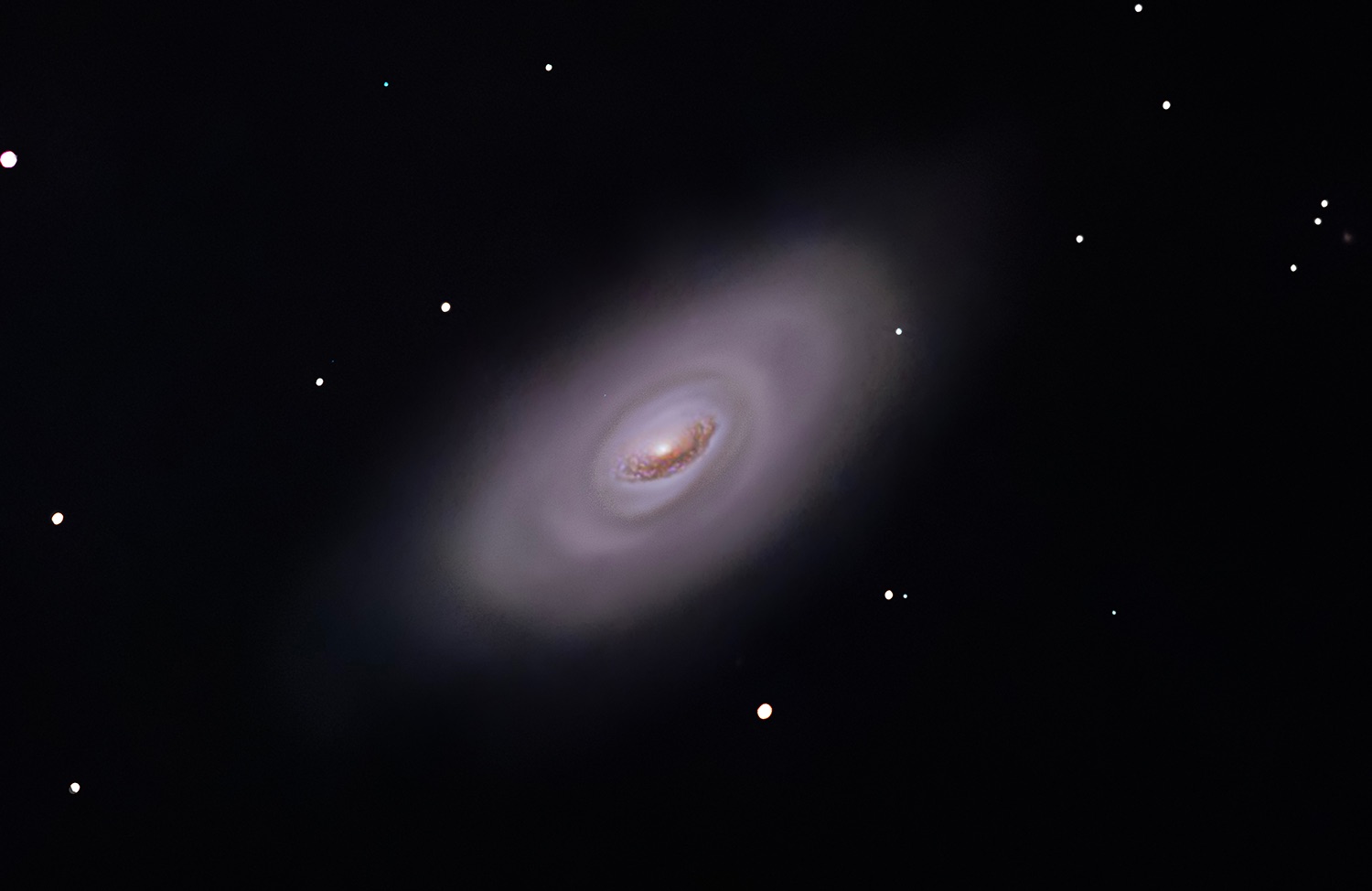
The Galaxy with a Shadowed Heart — M64, The Black Eye
On 02/09/2026 05:30 am by Jelieta Walinski Ph.D | Website | Desert Bloom Observatory, AZ, USA
n the quiet northern constellation of Coma Berenices lies Messier 64, a spiral galaxy whose beauty carries a striking imperfection — a dark band of absorbing dust sweeping across its luminous core. Because of this dramatic feature, astronomers call it the Black Eye Galaxy.
But this “black eye” is not an injury — it is evidence of cosmic history.
M64 sits about 17 million light-years from Earth and spans roughly 50,000 light-years across. Its most remarkable scientific trait is counter-rotation: the gas in its outer regions rotates in the opposite direction of the inner stars. This unusual motion strongly suggests that M64 absorbed a smaller galaxy long ago. What appears as a dark bruise is in truth the lingering signature of a galactic merger — gravity sculpting memory into structure.
Dark nebular dust clouds silhouette against billions of suns, revealing how light and shadow coexist in cosmic evolution. Star formation continues along the dust lanes, where cold molecular gas collapses into new stellar nurseries. Even apparent darkness is fertile.
Capturing this galaxy reminds us of something essential: such faint structures are visible only under protected skies. Light pollution does not just brighten the horizon — it erases history written in photons that have traveled millions of years to reach us.
To preserve dark skies is to preserve access to the universe’s memory. When we protect the night, we protect science, wonder, and truth itself.
May we guard the darkness — so galaxies like M64 may continue to speak
EHD8 Galaxy Equipments:
Mount: Sky-Watcher EQ-6R Pro Computerized Equatorial Mount S303000
Guide camera OAG & ZWO ASI220 Mini USB 2.0 Mono Guide Camera
Celestron .7x Focal Reducer for 8" EdgeHD Telescopes
Telescope: EdgeHD8
ZWO ASI2600MC Pro Color Camera (2025)
USB
ASIAir Plus
Images were stacked in DSS, processed in PI and PS