By Patricio Leon | 2026-02-20
Order by: Trending (past 30 days)Date
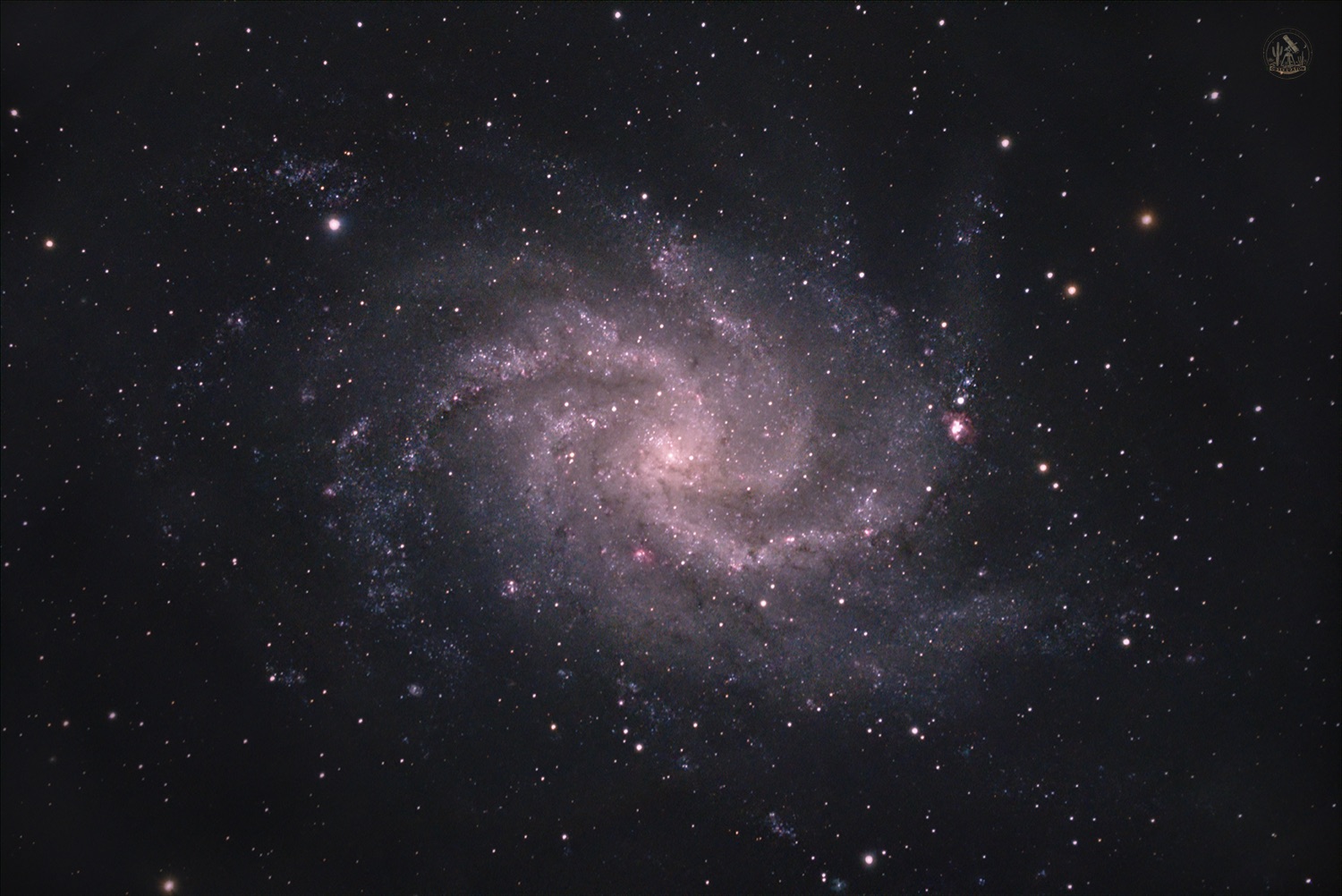
Uncropped Light: The Living Spiral of the Triangulum
On 02/05/2026 08:50 pm by Jelieta Walinski Ph.D | Website | Desert Bloom Observatory, AZ, USA
Floating nearly 2.7 million light-years away in the modest constellation of Triangulum lies Triangulum Galaxy (M33) — a grand design spiral that quietly rivals its more famous neighbor, Andromeda Galaxy. Though smaller than Andromeda and our own Milky Way, M33 is rich with sprawling hydrogen regions, luminous star-forming knots, and delicate, loosely wound spiral arms that breathe with stellar birth.
This image was captured at Desert Bloom Observatory using an EdgeHD 8” telescope with a 0.7× Celestron reducer. The frame remains intentionally uncropped — a deliberate decision to honor the galaxy’s full architectural presence within its cosmic environment. M33 does not demand to be zoomed in to impress; its beauty resides in context, in proportion, in the quiet balance between structure and surrounding space.
Unlike many grand spirals, M33 lacks a dominant central bulge. Instead, its light scatters softly outward, with massive H II regions — including the brilliant NGC 604 — glowing like celestial embers across its disk. These nurseries, powered by young, hot stars, sculpt the interstellar medium and shape the future evolution of the galaxy itself.
Yet images like this are fragile achievements. Every photon recorded here traveled for millions of years, only to risk being drowned in seconds by artificial skyglow. Dark skies are not a luxury for astronomers — they are a shared human heritage. Protecting them preserves not only scientific discovery, but our connection to scale, humility, and wonder.
If the surrounding horizon were heavily light-polluted, this delicate spiral would fade into obscurity. Its faint outer arms would dissolve. Its star-forming regions would blur into noise. The night sky would lose one of its quiet masterpieces.
Astrophotography is an act of patience — a long exposure against the rush of modern light. To preserve dark skies is to preserve the universe’s autobiography, written in photons older than humanity itself.
Mount: Sky-Watcher EQ-6R Pro Computerized Equatorial Mount S303000
Guide camera OAG & ZWO ASI220 Mini USB 2.0 Mono Guide Camera
Celestron .7x Focal Reducer for 8" EdgeHD Telescopes
Telescope: EdgeHD8
ZWO ASI2600MC Pro Color Camera (2025)
USB
Images were stacked using DSS, Processed in PI and PS