By Hassan Dadashi.Arani | 2026-02-16
Order by: Trending (past 30 days)Date
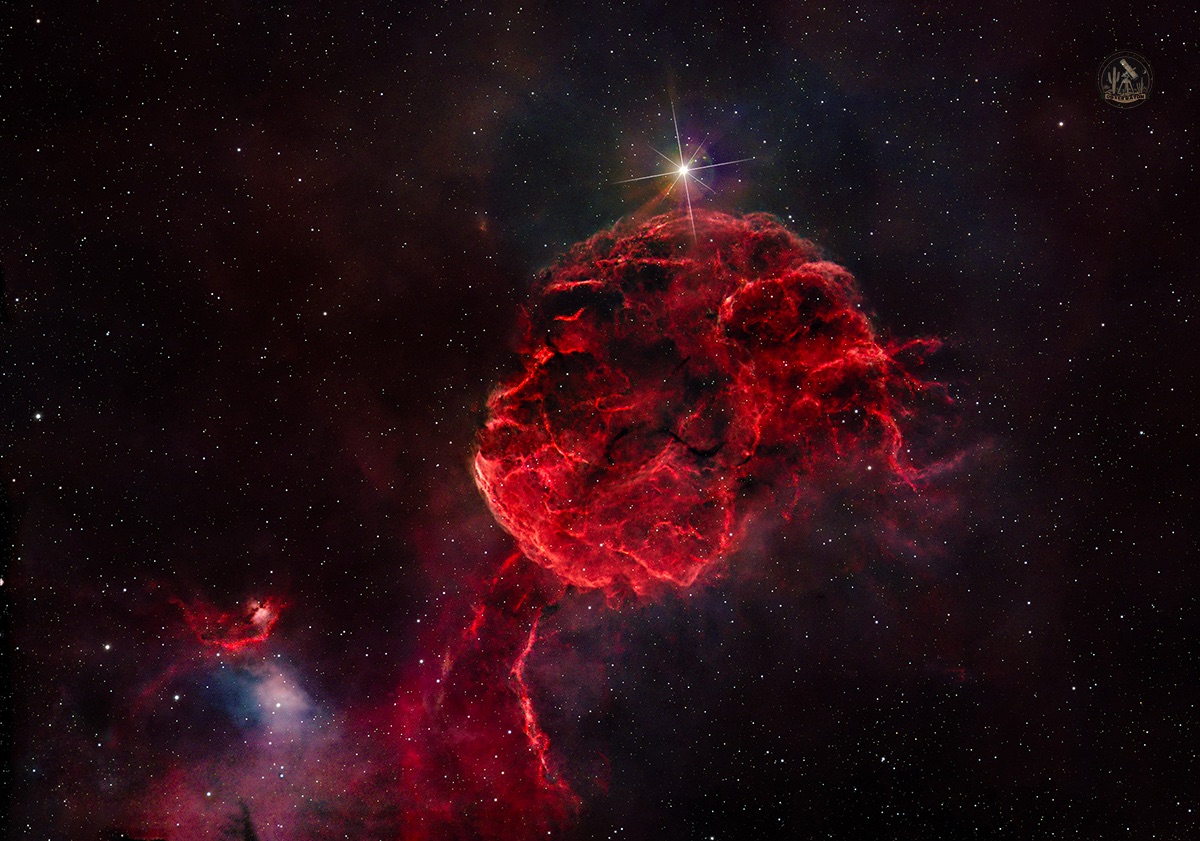
Sh2-248: The Jellyfish in the Quiet Sea of Night
On 02/10/2026 05:25 am by Jelieta Walinski Ph.D | Website | Desert Bloom Observatory, AZ, USA
Drifting through the constellation of Gemini lies Sharpless 2-248, more famously known as the Jellyfish Nebula — a vast supernova remnant cataloged in the Sharpless catalog.
This glowing structure is the expanding remains of a massive star that ended its life in a supernova explosion tens of thousands of years ago. What we see today is not the star itself, but its aftermath — shockwaves plowing into surrounding interstellar hydrogen gas, energizing atoms and causing them to emit the deep red light characteristic of hydrogen-alpha emission.
The “tentacles” that give the nebula its marine nickname are not fluid, but filaments of ionized gas shaped by magnetic fields and turbulent stellar winds. Embedded within this region lies the faint pulsar PSR J0538+2817 — the collapsed neutron core left behind after the explosion — still racing through space at extraordinary velocity.
This image represents 90 hours of integration captured under Bortle 2 dark skies at Desert Bloom Observatory. Such pristine darkness is not merely aesthetic — it is essential. Faint supernova remnants like Sh2-248 emit delicate signals that are easily drowned by artificial light pollution. Dark skies preserve our ability to detect the whisper of dying stars, to measure faint shock fronts, and to study the chemistry of stellar debris that will one day seed future generations of stars and planets.
Light pollution does more than hide beauty — it erases data. It blinds our detectors to the subtle physics written in faint photons.
Under protected night skies, however, the universe reveals its memory.
The Jellyfish Nebula reminds us that stellar death is not an ending, but a transformation — a recycling of matter into the cosmic ocean. And in that quiet sea of darkness, we are given the privilege to witness it.
>Telescope: Celestron Nexstar Evo 9.25 235mm f/10 Schmidt Cassegrain
>Camera: ZWO-ASI2600MCPRO
>Mount: Sky-Watcher EQ-6R Pro Computerized Equatorial Mount S303000
>Guide Scope: ZWO 30F4Miniscope
>Guide Camera: ZWO ASI462 MC Planetary Camera
>Starizona Hyperstar 4HS4-C9.25 white 10014
>ZWO standard Electronic Automatic Focuser EAF-5V
>ZWO ASIAir Plus Wifi Camera Controller
>Optolong- L-Pro 2” multiband Pass Filter
>Samsung Cellular Phone
>Memory Card
Images were stacked in DSS, processed in PI and PS