By Patricio Leon | 2026-02-12
Order by: Trending (past 30 days)Date
ᴛʜᴇ ᴘᴇʀꜰᴇᴄᴛ ʀᴇꜱᴛʟᴇꜱꜱɴᴇꜱꜱ ᴏꜰ ᴇᴀʀᴛʜ
On 02/01/2026 11:30 pm by SAMIT SAHA | Website | DODA, JAMMU AND KASHMIR, INDIA
ᴛʜᴇ ᴘᴇʀꜰᴇᴄᴛ ʀᴇꜱᴛʟᴇꜱꜱɴᴇꜱꜱ ᴏꜰ ᴇᴀʀᴛʜ
A massive planet nearly 12,700 kilometres in diameter, with a core temperature touching 5,000 degrees Celsius, while its outer skin experiences extremes — a maximum of 57 degrees and a minimum of −89.2 degrees Celsius. At the equator, Earth spins at a speed of about 1,670 kilometres per hour, yet at the poles, this daily motion drops to almost zero.
In its annual journey around the Sun, Earth races at nearly 107,000 kilometres per hour. That means the completion of a single year corresponds to a staggering journey of about 940 million kilometres — and yet, not a single drop of tea spills from our cups.
Meanwhile, the Sun itself, carrying the entire solar system along, orbits the centre of the Milky Way at nearly 230 kilometres per second. This motion belongs to Earth as well, translating to a galactic speed of roughly 800,000 kilometres per hour. At this pace, our planet takes about 225 million years to complete one revolution around the Milky Way’s core.
And yet, neither birds nor beasts sense this terrifying restlessness. The chaos is so perfectly balanced that even as we fall asleep peacefully, we traverse millions of kilometres — all without awareness.
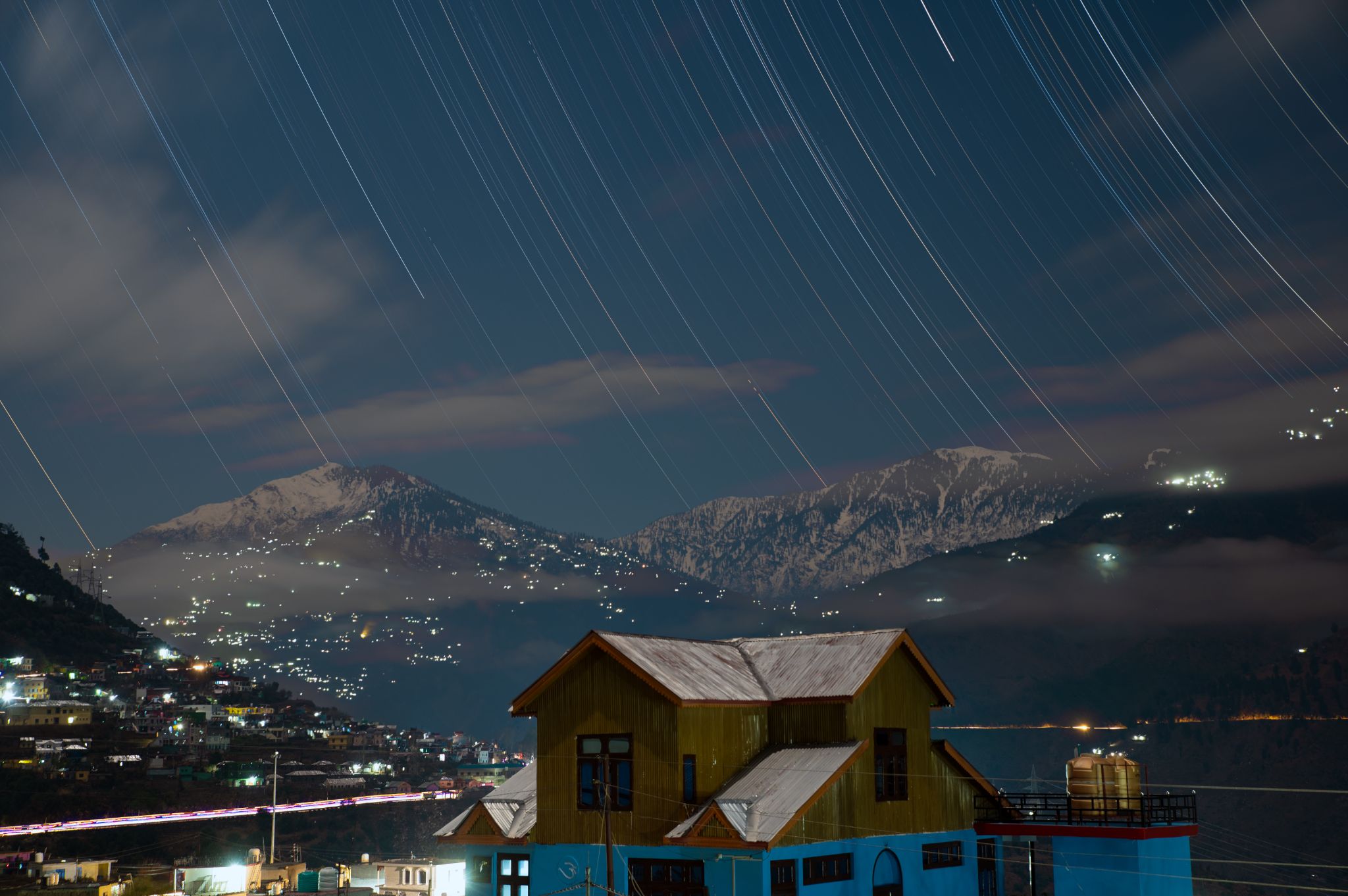
To grasp how much this spinning, top-like Earth moves within just a few hours of a single night, one only needs to look at the countless stars scattered across the infinite sky. Gradually, it becomes apparent: the entire sky is in motion. The heavens themselves are rotating, following paths dictated by the precise mathematics of the universe.
Light that has travelled unimaginable distances from those stars was captured here as star trails. On this night, the mountain peaks of Jammu and Kashmir were either freshly dusted with snow or just on the verge of it. The silvery Moon bathed the landscape in gentle light, illuminating the atmosphere — and still, a few stellar rays sliced through the sky, leaving behind their colours.
Nikon Z6ii + Tamron 24-70 @50mm on Benro Tripod
Photoshop and Adobe Camera Raw