By Hassan Dadashi.Arani | 2026-02-10
Order by: Trending (past 30 days)Date
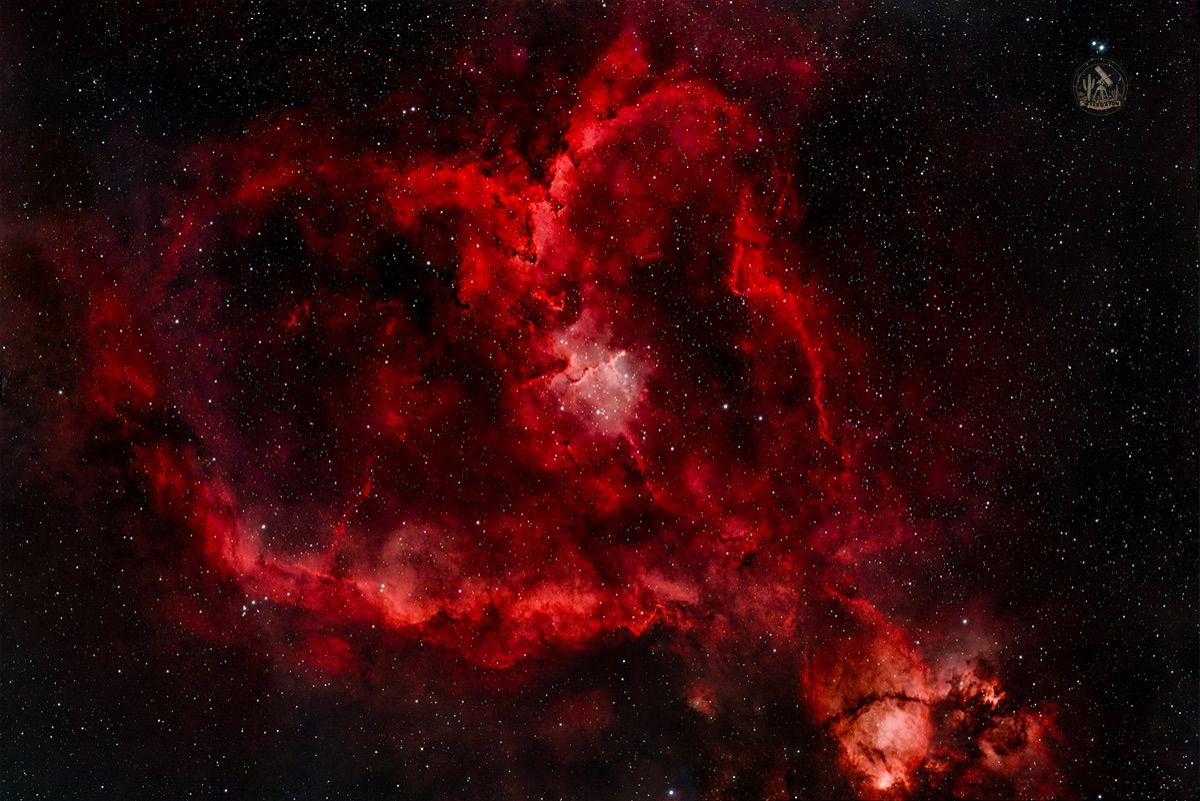
A Heart That Learned to Shine
On 01/13/2026 08:07 pm by Jelieta Walinski Ph.D | Website | Desert Bloom Observatory, AZ, USA
Explanation
Why does a nebula resemble a heart?
Because physics, when patient, can look like poetry.
Located about 7,500 light-years away in the Perseus Arm of the Milky Way, the Heart Nebula (IC 1805) is a vast emission nebula nearly 200 light-years across. Its characteristic red glow comes from ionized hydrogen gas, energized by intense ultraviolet radiation from massive young stars embedded within the open cluster Melotte 15 near its center.
These energetic stars sculpt the surrounding interstellar medium through radiation and stellar winds, carving dark dust lanes and glowing filaments while simultaneously triggering new star formation. This interplay of destruction and creation defines stellar nurseries like IC 1805.
This image is the result of approximately 60 hours of total integration, revealing faint shock fronts, delicate dust structures, and subtle emissions from oxygen and sulfur in addition to hydrogen. Captured near Valentine’s Day, the Heart Nebula serves as a reminder that even on cosmic scales, time, energy, and gravity can shape something that feels deeply familiar.
Image Details
Object: IC 1805 – The Heart Nebula
Type: Emission Nebula / Star-forming Region
Distance: ~7,500 light-years
Size: ~200 light-years
Total Integration: ~60 hours
Filters: Narrowband (Hα, OIII, SII)
Constellation: Cassiopeia
>Telescope: Celestron Nexstar Evo 9.25 235mm f/10 Schmidt Cassegrain
>Camera: ZWO-ASI2600MCPRO
>Mount: Sky-Watcher EQ-6R Pro Computerized Equatorial Mount S303000
>Guide Scope: ZWO 30F4Miniscope
>Guide Camera: ZWO ASI462 MC Planetary Camera
>Starizona Hyperstar 4HS4-C9.25 white 10014
>ZWO standard Electronic Automatic Focuser EAF-5V
>ZWO ASIAir Plus Wifi Camera Controller
>Optolong- L-Pro 2” multiband Pass Filter
>Samsung Cellular Phone
>Memory Card
Images were stacked in DSS, brought to PI, and Photoshop