By Eliot Herman | 2025-12-19
Order by: Trending (past 30 days)Date
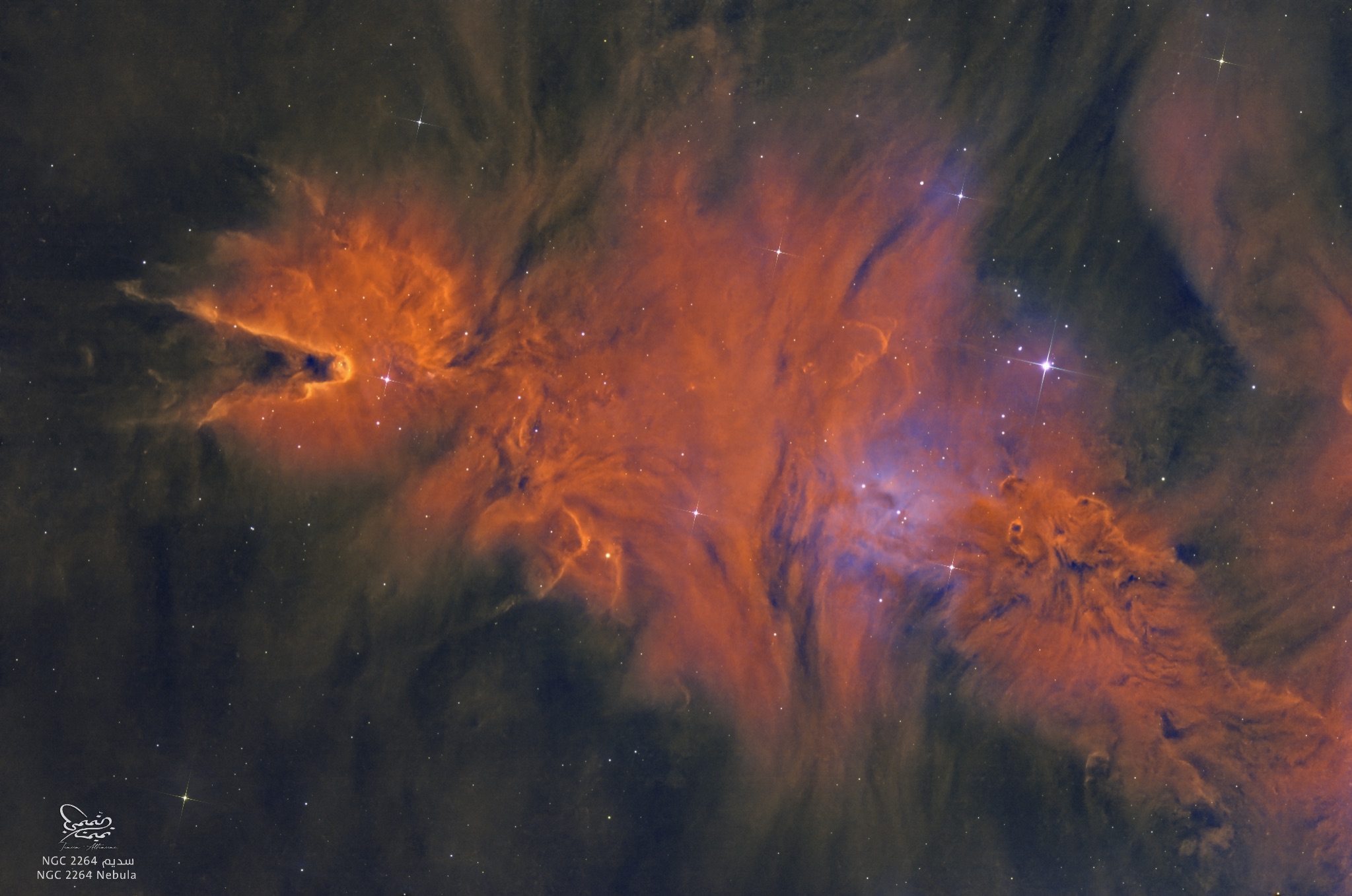
The Fox Fur Region of NGC 2264
On 12/13/2025 02:00 am by Tameem Altameemi | Website | United Arab Emirates
What sculpts the flowing clouds of gas within NGC 2264? Radiation and stellar winds from young, massive stars play the leading role. Located about 2,500 light-years away in the constellation Monoceros, NGC 2264 is a complex star-forming region that includes glowing nebulae, dark dust lanes, and newly born stars still embedded within their natal clouds. The emission region shown here is commonly known as the Fox Fur Nebula, named for its filamentary, fur-like appearance.
Captured in narrowband hydrogen-alpha (Hα) and oxygen (OIII), this image reveals turbulent structures shaped by energetic feedback from young stars. Bright hydrogen emission traces regions of ionized gas, while oxygen highlights higher-energy zones where stellar winds and radiation interact strongly with the surrounding material.
The sweeping filaments and shadowy cavities seen here mark an active environment where star formation and erosion occur side by side. Over time, these structures will continue to evolve, gradually dispersing into the interstellar medium as the stars reshape the clouds from which they were born.
• Telescope: Sky-Watcher Quattro 200P
• Mount: iOptron HAE43
• Camera: ZWO ASI183MM Pro (cooled, 0°C, Gain 111)
• Filters: Narrowband Hα and OIII
• Guiding: Svbony 30mm + ZWO ASI290MM
• Acquisition Software: ASIAir
Exposure:
• Hα: 30 × 180s
• OIII: 30 × 180s
• Total integration: 3 hours
Pixinsight and Photoshop