
By Cecille Kennedy | 2025-12-17
Order by: Trending (past 30 days)Date
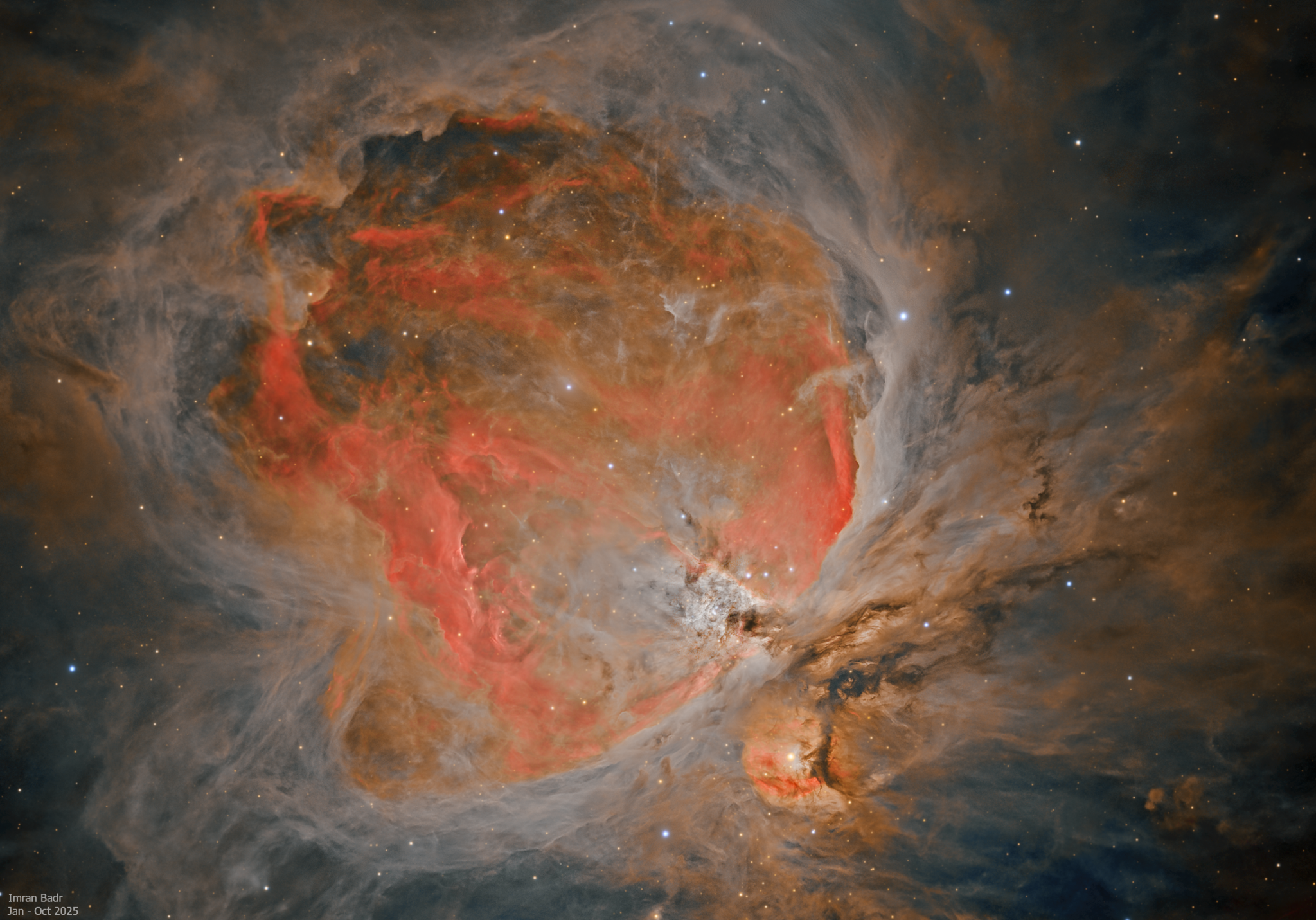
Swirls of gases and dust of Orion nebula
On 10/19/2025 by Imran Badr | Website | San Jose, CA, USA. Bradley, CA, USA
The Orion Nebula (M42) is one of the brightest and most studied nebulae in the night sky, located about 1,350 light-years away in the constellation Orion. I wanted to show the delicate swirls of gases in this amazing deep space target. Due to very high brightness, such details are often hidden. I attempted this target using three telescopes, mounts and cameras. Processing was extremely challenging and it took me a long time to arrive at this version.
Telescopes:
Sky-Watcher Esprit 100ed
Askar FRA 300 pro
Sharpstar 13028 HNT
Mounts:
ZWO AM5, 2xZWO AM3
Cameras:
3x ZWO ASI2600MM Pro
Filters:
Optolong R,G,B
ZWO R,G,B
Antlia v-pro R,G,B
Antlia 2.5nm S,H,O
Antlia 3nm Highspeed O3, and Ha
Exposures:
R: 3h6m10s (5s,10s,30s,60s,120s)
G: 3h44m40s (5s,10s,30s,60s,120s)
B: 2h57m (5s,10s,30s,60s,120s)
Ha: 10h28m30s (15s, 30s, 120s, 180s, 240s, 300secs)
S2: 1h22m (30s, 120s)
O3: 7h43m (30s,120s,180s)
Total Integration:
29h21m20s
Software:
PixInsight, Photoshop
After calibration, regustration and integration of S, H, O, R, G and B, I carefully added S and H to Red and O to B and G after continuum subtraction. Tgat enhanced the details. After that it was hours and hours and multiple attempts of carefully stretching and color enhancements to arrive at this version. It is one of the most easily caotured objects but the most challenging to process in my opinion.
I used careful stretching to avoid bloating the bright core and show whispie clouds of dust.
