
By Hassan Dadashi Arani | 2025-12-02
Order by: Trending (past 30 days)Date
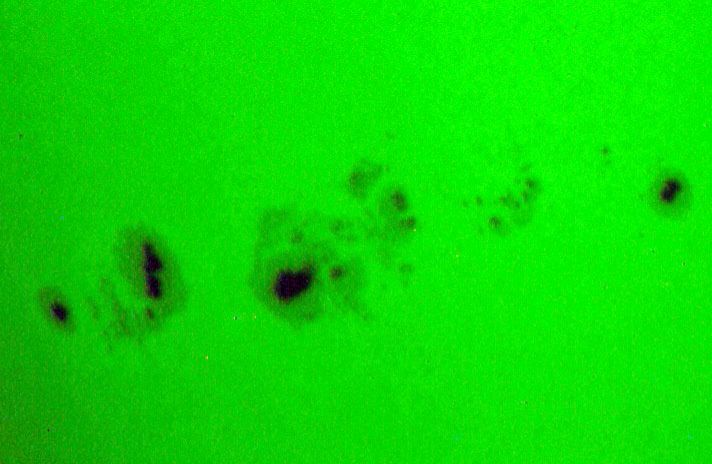
Behemoth Sunspot complex
On 12/02/2025 10:15 am by Victor Rogus | Sedona, Arizona
A new NOAA model of yesterday's X2-class solar flare and CME suggests that the CME might not miss Earth after all. The storm cloud could graze our planet on Dec. 3rd. Moreover, the CME will scoop up a solar wind stream just ahead of it, adding heft to the potential impact. G2-class geomagnetic storms are possible on Dec. 3-4. Aurora alerts!!!
On Sept. 1, 1859, English astronomer Richard Carrington sketched the most famous sunspot in history. While Carrington was watching an image of the sun projected on a screen, the sunspot produced a blinding X45-class solar flare, followed two days later by a planet-wide geomagnetic storm. We call it the "Carrington Event."
The image shows Carrington's drawing of the 1859 sunspot shows that.new sunspot 4294-4296 are about the same size. The surface area of Carrington's sunspot was ~2300 millionths of the solar disk. The surface area of 4294-4296 is about 90% as large.
To be clear, 4294-4296 is actually two sunspots. Their close proximity makes them appear as a single behemoth--an unfair advantage vs. Carrington. Even so, strong explosions are likely. The crowding of the two sunspots' magnetic canopies raises the odds of reconnection and an X-flare of their own. Any explosions today will be geoeffective.
Jaegers 103 mm refractor, Bader Planetarium safety wedge, losmandy GM-8 mount. Canon 60Da camera
none
