By Hassan Dadashi Arani | 2025-11-06
Order by: Trending (past 30 days)Date
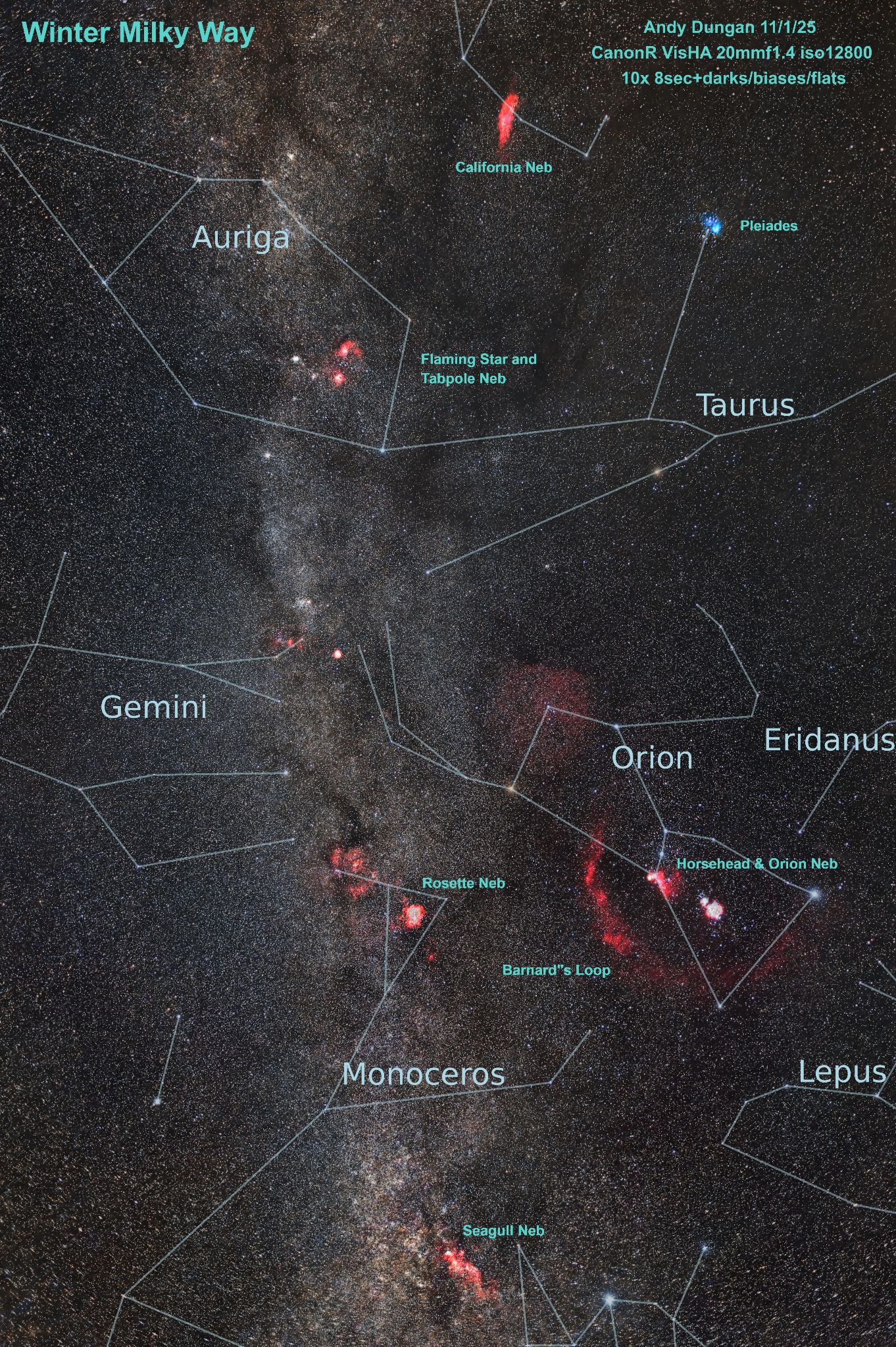
The Winter Milky Way
On 11/01/2025 02:00 am by Andy Dungan | Website | Near Cotopaxi, Colorado USA
Like I said above I have been working on an ultra widefield image using PI for 7+ months and this is the first time I have succeeded enough to be willing to share the pic.
I enjoy widefield as much as deep space. The thing I most enjoy about this pic is that it gives you and idea of all the things out there in space from a relatively large scale and it gives you some idea of relative sizes.
It’s all part of exploring space from my home! It was so exciting to finally finish an ultra widefield image using PI 100%.
CanonR VisHA 20mmf1.4 iso12800, 10x 8sec +darks/biases/flats, on a tripod
No tracking mount used
PixInsight 100%.
I have essentially been working on this picture for something like 7 months and have failed numerous times for one reason or another. I got the idea for this pic from Trevor Jones of Astrobackyard (https://astrobackyard.com/wide-field-astrophotography-processing-tutorial/). My goal was to figure out how to do the pic with PixInsight 100%. While I have managed to pull off many pics of deep space objects using PixInsight 100%, doing the same for ultra widefield images has proved far more challenging. Hopefully I will continue to improve.
The part of this attempt that surprised me is that I decided to try taking the pics without tracking just as I would do for regular milky pics with my 20mm f1.4 lens. There are a number of challenges to using PI for ultra widefield. One of the first is how you get a astrometric solution in PI so you can have PI actually plot the constellation lines on your pic.