By Linda Cunningham | 2025-11-04
Order by: Trending (past 30 days)Date
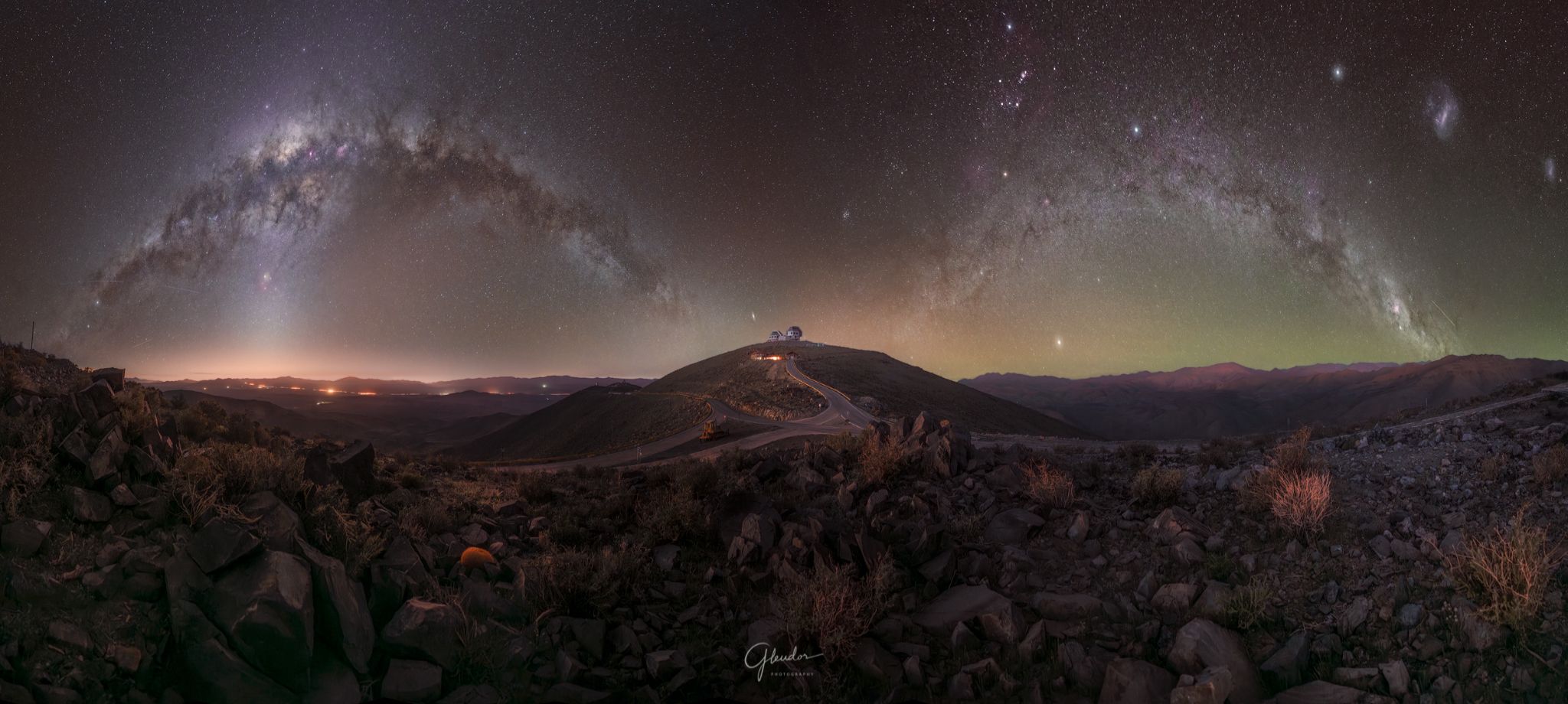
One Night, Two Hemispheres of the Sky, and an Entire Galaxy Reflected in the Eyes of the Giants of Las Campanas
On 10/21/2025 03:00 am by Glendor Díaz | Website | LAS CAMPANAS OBSERVATORY (Chile)
A week ago, a group of astrophotographers joined the LUZLUX and Sernatur project to discover and document the great natural and astronomical treasures of the Coquimbo and Atacama regions in Chile, among them their greatest heritage: the night sky.
During the night of October 20–21, 2025, we visited the Las Campanas Observatory, atop the mountain range of the same name, home to the Magellan Telescopes. The conditions were exceptional to attempt one of the most symbolic images of the southern hemisphere: the double arc of the Milky Way captured in a single night.
We began photographing the first arc around 10:00 p.m., with the Galactic Center descending over the western horizon, wrapped in Zodiacal Light. Around 3:00 a.m., the second arc rose in the east, allowing both panoramas to be combined into a complete and unique view of our galaxy.
The image reveals Venus, Andromeda, Rigel, Betelgeuse, the Pleiades, the Large and Small Magellanic Clouds, and constellations such as Orion, Scorpius, Taurus, Carina, Centaurus, and Canis Major, all bathed in a soft airglow.
The photograph, captured by Glendor Díaz with the collaboration of Fernando Rey, Jordi Coy, Pablo Alfranca, and Cristóbal Vergara (Tembeta), was made possible thanks to the authorization of the Carnegie Institution for Science.
Credits: © Glendor Díaz / LUZLUX
Location: Las Campanas Observatory, Coquimbo Region, Chile (29°00′S, 70°42′W)
Date of Capture: October 20–21, 2025
Sony Alpha 7IV; Pergear 14 mm lens; f/2.8; 30 s exposure; ISO 5000. Three stitched panoramas without artificial lighting
Three panorama assembly in Autopano and color correction in Adobe Photoshop; minimal noise reduction with Topaz Denoise and contrast adjustment to naturally preserve the airglow and Zodiacal Light.