By Kevan Hubbard | 2025-10-06
Order by: Trending (past 30 days)Date
Comet C/2022 E3 (ZTF)
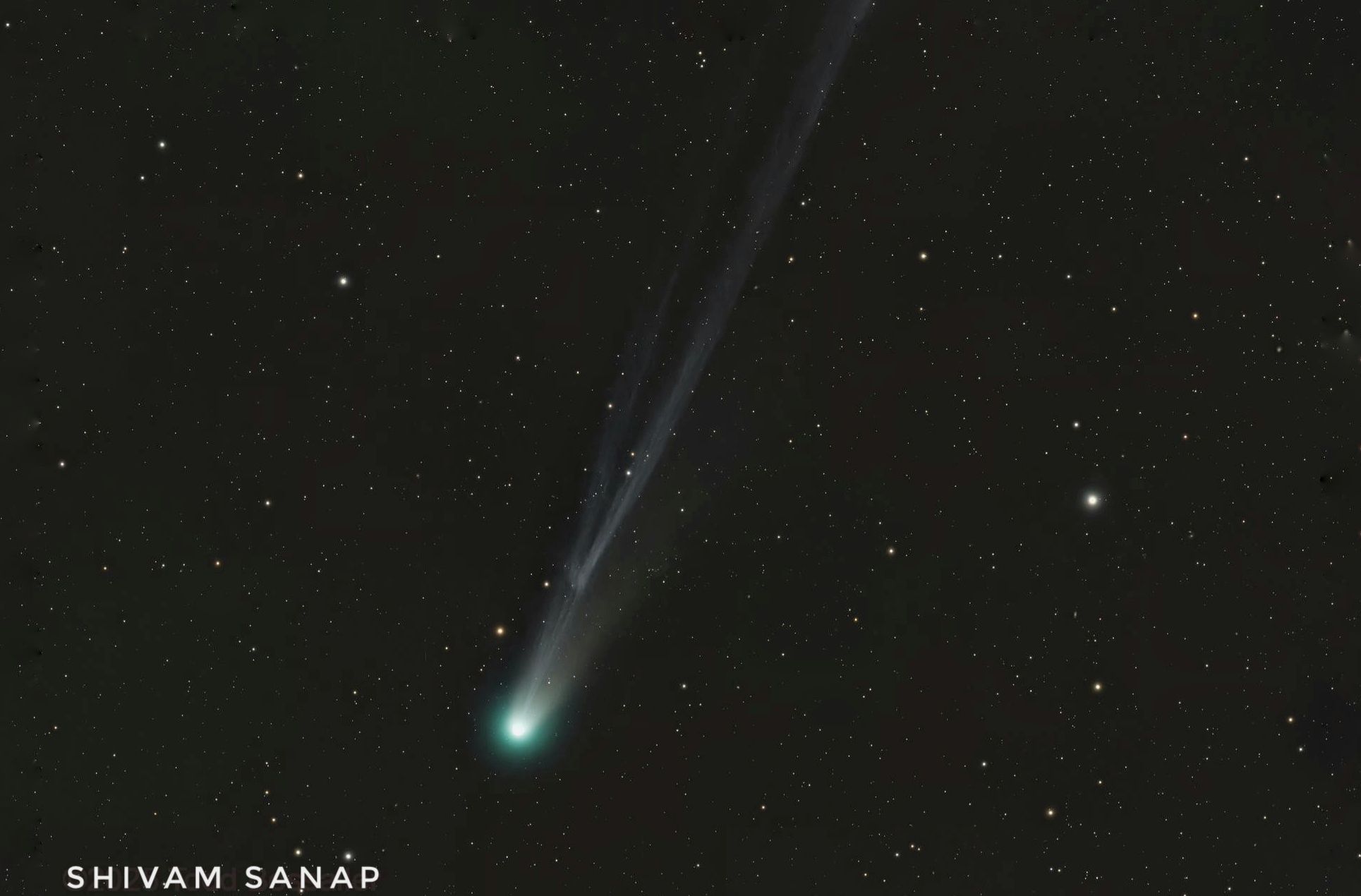
On 09/28/2025 11:00 pm by Shivam Sanap | Website | Pune , Maharastra
Hello everyone, I'm Shivam Sanap, an astrophotographer from Manmad. Today, I captured Comet C/2022 E3 (ZTF). It was a truly amazing experience
Telescope/Lens: A relatively fast, medium-to-wide field instrument is ideal for comets to capture the whole tail. This would typically be a Refractor Telescope (like an Apochromatic Refractor with a focal length around 400mm-600mm) or a fast telephoto camera lens (e.g., a 200mm or 300mm lens at f/2.8 or f/4).
Imaging Camera: A camera with excellent low-light performance is necessary. This would be a Dedicated Astronomy Camera (such as a ZWO ASI model) or a high-quality, modified DSLR/Mirrorless Camera (like a Canon or Nikon model)
1. Pre-Processing / Calibration
Calibration Frames: All raw light frames are first calibrated using Dark frames (to remove thermal noise), Flat frames (to remove dust and correct for vignetting), and Bias/Dark-Flat frames (to remove electronic readout noise).
2. Comet-Specific Stacking (The Critical Step)
The main challenge is that a single stack (alignment) cannot keep both the fast-moving comet and the slower-moving stars sharp. Therefore, astrophotographers perform dual-stacking:
Stack 1: The Comet Image (Sharp Comet, Trailed Stars)
The individual light frames are run through a special tool (like Comet Alignment in software such as PixInsight or DeepSkyStacker).
The software identifies the comet's nucleus and stacks every frame to align on the comet's position.
The result is a highly detailed, clean image of the comet, but the background stars are slightly blurred or trailed because they were moving relative to the comet during the exposure.