By Adeel Shafiq | 2025-03-21
Order by: Trending (past 30 days)Date
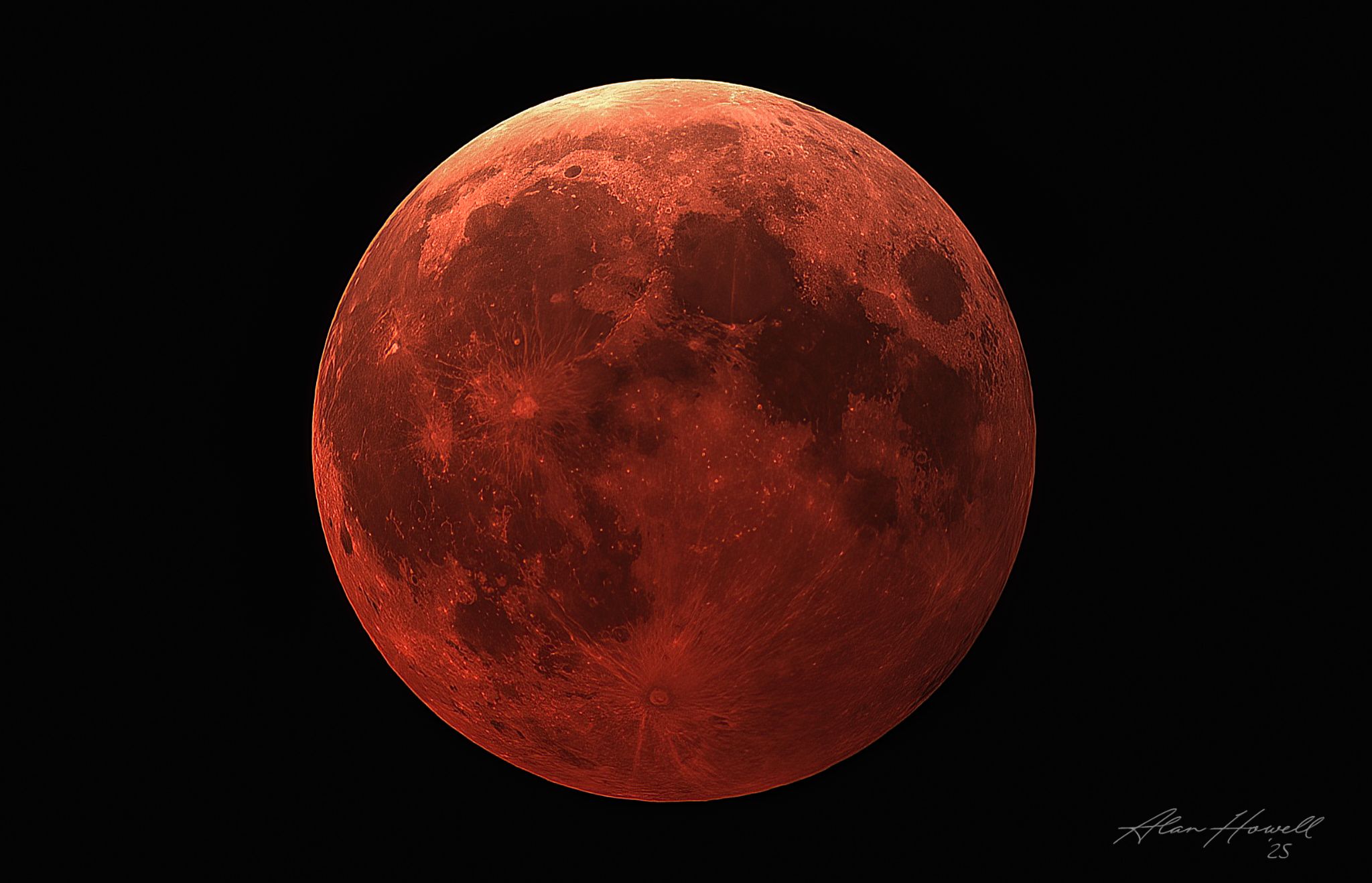
Lunar Eclipse Totality in 2025
On 03/14/2025 03:06 am by Alan Howell | Website | Boone, NC
I captured the 2025 'Blood Moon' total lunar eclipse from Boone, NC using a dedicated astro camera and a 72mm refractor in video mode, stacked with the best 25% of the frames. No color adjustments were made as I wanted to convey the beautiful reddish cast in its most true-to-eye natural color.
This image shows the Moon in peak totality inside the Earth's shadow, called the umbra. The red color comes from sunlight that is being refracted through the Earth's atmosphere, creating a deep orange-red glow. It's essentially as if all the Earth's sunsets are casting their reddish light on the Moon at once. The blue wavelengths of sunlight get scattered out in the Earth's atmosphere, leaving the longer wavelengths of red light to pass through, and onto the Moon's surface.
While I've photographed several total lunar eclipses in my life, this one was very special to me for several reasons. The story below tells of my journey in capturing this rare view...
In my home area, a couple days before, the eclipse was forecasted to be partially clouded out. So, I made the decision to drive two hours West to our family farm to hopefully photograph it in better skies. While a lunar eclipse doesn't require super dark skies, the remote and high elevation Bortle 4 skies of Western NC would certainly be better for viewing than my light-polluted, suburban Bortle 6 skies back home. The quiet peacefulness of the rural farmland would also be a nice benefit, as it always calms my mood and helps me push through the week's stress of work, recent doctor visits, and physical therapy for my chronic back pain. This trip was as much an escape as an opportunity.
I arrived at the farm in mid afternoon, and began the long, methodical process of setting up the telescopes and small acquisition computers. Moving slowly, it took perhaps four hours to get things set up for the obligatory testing of the telescopes. With three telescopes and two camera lenses, offering eight different possible views, I had more gear than anyone should really need for such an event. But as fate would have it, it turned out to be 'just enough' to get the job done.
I had originally wanted to capture the eclipse using my DSLR with the refractor as it would give a full disc view of the moon, (with a little room to spare). Unfortunately, the DSLR's connection cable to the acquisition computer decided to stop working during testing, so this meant I would have to quickly come up with a new telescope configuration for imaging. I eventually decided on pairing my Astro-Tech 72EDII refractor with a focal reducer/flattener, and the ASI183MC Pro astro cam. If I used this pairing in 'video mode', it would allow an 'almost full view' of the Moon in color. To get the final full disc image, I would have to take a multi-photo mosaic using several photo panels that I stitched together. Not my original plan, but so be it.
As the night progressed, just after 10:30pm, the clouds started to thin and push out to the East, leaving a nice bright full moon view, and a colorful red-yellow-blue halo around the Moon...an optical illusion caused by the refraction of moonlight through ice crystals in the upper atmosphere, typically in thin cirrus or cirrostratus clouds. A nice bonus for this night, indeed.
I had two telescopes set up, one for visual observation, a 1300mm Maksutov-Cassegrain reflector, and a 72mm doublet refractor for imaging. The views through the reflector scope were truly awe inspiring, showing bright, razor sharp detail in the craters and ejecta lines over the mare. It was still a full moon, but I knew as the eclipse would start to begin after midnight, I would get to see how the Earth's shadow, specifically its dark, inner core, called the umbra, would slowly creep over the mountains of the Moon, and slide into the lunar valleys and craters. I was almost trembling with excitement and anticipation in the cold night, perhaps with a bit of nervousness, at the technical challenge of photographing all the phases of the eclipse, from the penumbral phases, through totality, and eventually back to the bright, full moon.
Around 11pm, with a little coaxing, I was able to show my 82 year old father his first view of the Moon through a high-powered telescope, to which he was genuinely amazed. His response, 'WOOOW!! It's so bright and clear!". We talked about the scope's amazing clarity and magnification, and I explained what a lunar eclipse is, and what it would look like during totality. Just before heading back inside from the cold, he said, "You're going to get some pictures of it so I can see it in the morning, right?" I replied, "I'll certainly do my best pop."
While he couldn't stay up for the big show of the eclipse, I considered this a victory in sharing this lunar view. As the initiated will tell you, seeing the Moon for the first time with your own eyes in a big telescope makes it somehow more 'real', deepening our internal understanding of it, and our place in the solar system. We are, after all, connected to the Moon and solar system in ways most do not fully realize. We are one in our constituent elements. The Moon's gravitational interactions on us are powerful, impacting Earth's tides, climate, and even the rhythm of life.
As the temperature dropped, I put on my heavy coat, fleece hat and gloves, and the skies cleared just in time for the penumbral phases to begin, The visual views through the 1300mm scope were even better than I had expected. I could see the full disc of the Moon in the 40mm eyepiece, and crystal clear zoomed in views in the 15mm eyepiece. I snapped a few still images in the other scope to mark the beginning of the eclipse.
Looking at the surface features, I couldn't help but think of something I heard a couple days earlier that would make this particular eclipse even more special. On March 2nd, the Blue Ghost Lunar Lander from Firefly Aerospace, landed on the moon with science instruments, and Firefly made the decision to attempt to capture the eclipse from the Moon, before finally shutting down due to the extreme cold (-148F / -100C) of lunar night. Meaning, it would be capturing a total SOLAR eclipse in high-resolution images from the Moon, the first in history, as a bonus part of its science mission, while we were seeing the total LUNAR eclipse here on Earth. Pretty cool stuff.
As the Earth's shadow moved across the face of the Moon, I was elated that my star tracking mounts holding the telescopes were tracking well and that I didn't have to make too many adjustments on the fly. My tight polar alignment on the North Star, (aka Polaris) had paid off. I began capturing video frames in full HD with the astro camera. I would ramp up the exposure during totality to bring out the reddish color on the Moon, and extra details in the craters and lunar mountains ranges. I could even see collapsed lava tubes, craters within craters, and super bright white spots on the moon from relatively recent meteor impacts.
Looking at the eclipse during totality with the naked eye was stunning. Somehow it gives a slight eerie feeling as it's such a rare and bizarre event, so completely different from any full moon view we are used to seeing. It's no wonder why these celestial events caused the ancients from civilizations past to make up stories, myths, and legends about them...unfortunately, often fear-induced warnings, or forebodings of imagined bad luck ahead, or that some sky or Moon god was angry with the people.
Sometimes too, albeit less often, they were seen as good omens and a foreshadowing of prosperous times coming. Why they chose a positive or negative interpretation, who knows, as often astrologers in places right beside each other geographically would have completely opposite interpretations of what the eclipse 'meant'. Much like astrological interpretations still today, from one newspaper or website to another, it's odd how they never really seem to sync up in their messaging. (Hence why I choose to stick with actual evidence-based fact and direct observation over fear-based myth and assumptions of what is occurring in the sky). Through direct observation, knowledge is power. And for mankind, less fear the better.
As totality gave way to the intensely bright edges of sunlight returning to the Moon's East limb, I continued to capture each phase. I could feel myself relax a little as the crux of totality and the operational chaos of running multiple scopes at once was completed successfully. My goal was a full eclipse timelapse video that I would eventually pull still images from for this final image of the 'Blood Moon'.
As the moon returned to its bright, full moon phase, I snapped a few final images and my last video file. I turned off the tracking mounts and cameras, shut down the computers and turned on the dew heaters to keep the scopes from fogging up as I brought them back inside. Mission accomplished, I was tired, sore, but deeply satisfied.
Overall, despite the camera cable setback, I'm quite pleased with the final result in this image, capturing a wonderful memory for both me and my father. I hope you enjoy it as well.
Astro-Tech 72EDII doublet refractor, .7X focal reducer/flattener, ASI183MC Pro cooled astro camera, UV/IR cut filter
Prepped in PIPP, processed in AstroSurface and Photoshop